

Diagnostic Identifiers of Foundation Settlement in Bay Area Homes
You can identify foundation settlement in Bay Area homes by observing persistent diagonal drywall cracks near opening frames, binding doors and windows, uneven floor slopes, and cracking along concrete stem walls. These distinct physical symptoms occur when differential settlement stresses timber and concrete framing beyond structural tolerances, pulling the building framing out of square.
In our decades of structural engineering field work across Oakland, Berkeley, Walnut Creek, Concord, and Clayton, we routinely observe how regional microclimates affect foundation integrity. The primary driver behind local foundation sinking is the presence of expansive clay soils, predominantly montmorillonite adobe clay. When winter rains saturate the soil, the ground expands significantly, exerting upward pressure on concrete footings; during dry summer months, the soil loses moisture and shrinks, causing footings to sink unevenly.
Understanding this cyclical shift requires specific conditional logic during home evaluation. If drywall cracks exceed 1/8 inch in width or display vertical offset where one side protrudes further than the other, prioritize immediate structural elevation mapping. If cracks remain uniform, hairline width, and do not expand during dry months, monitor the area quarterly while improving surface perimeter drainage. According to geotechnical documentation compiled by Geology.com, expansive clays produce swelling pressures reaching up to 5,500 pounds per square foot, making soil movement the single largest physical cause of residential foundation structural failure.
- Diagonal cracks wider than 1/8 inch extending from interior door and window lintels.
- Gaps opening between floor trim, baseboards, and hardwoods or tile flooring.
- Exterior concrete stem walls displaying step-cracking through mortar joints or solid concrete.
- Doors swinging open or closed independently due to frame distortion out of plumb.
Real-World Case Study: Resolving Differential Settlement in Berkeley Hills
We resolved severe differential settlement on a historic Berkeley Hills residence experiencing a 3.5-inch floor elevation drop by installing engineered steel helical piers beneath the foundation stem wall. This intervention anchored the home directly into stable bedrock, eliminating soil-induced lateral sliding and halting vertical downward displacement permanently.
When we arrived on site, the homeowner had experienced progressive structural distortion over three years. We identified a key failure mode in a previous contractor attempt: localized epoxy crack injection had been applied to an active structural fracture without addressing the underlying soil movement. Because the stem wall was continuing to sink into uncompacted fill soil, the rigid epoxy failed completely within 18 months, causing wider structural splitting in the cripple wall framing above.
To permanently correct the structural mechanics of the residence, our crew executed a complete foundation underpinning protocol:
- Conducted specialized torque-monitored core drilling around the perimeter to verify load-bearing rock depth at 22 feet beneath surface soil.
- Excavated targeted access pits adjacent to concrete footings to expose sound structural concrete for lifting brackets.
- Mechanically advanced eight industrial helical piers into stable bedrock using hydraulic drive equipment until reaching design specification capacity.
- Attached heavy-duty steel foundation brackets to the footing and hydraulically lifted the home back to within 0.25 inches of original level alignment.
Professional Inspection Protocols and Diagnostic Frameworks
We evaluate structural settlement using precision digital floor elevation mapping, crawl space moisture analysis, and soil load testing. By mapping elevation profiles across the footprint down to fractional inches, we isolate deep soil settlement from localized framing sag, allowing us to specify targeted structural stabilization measures.
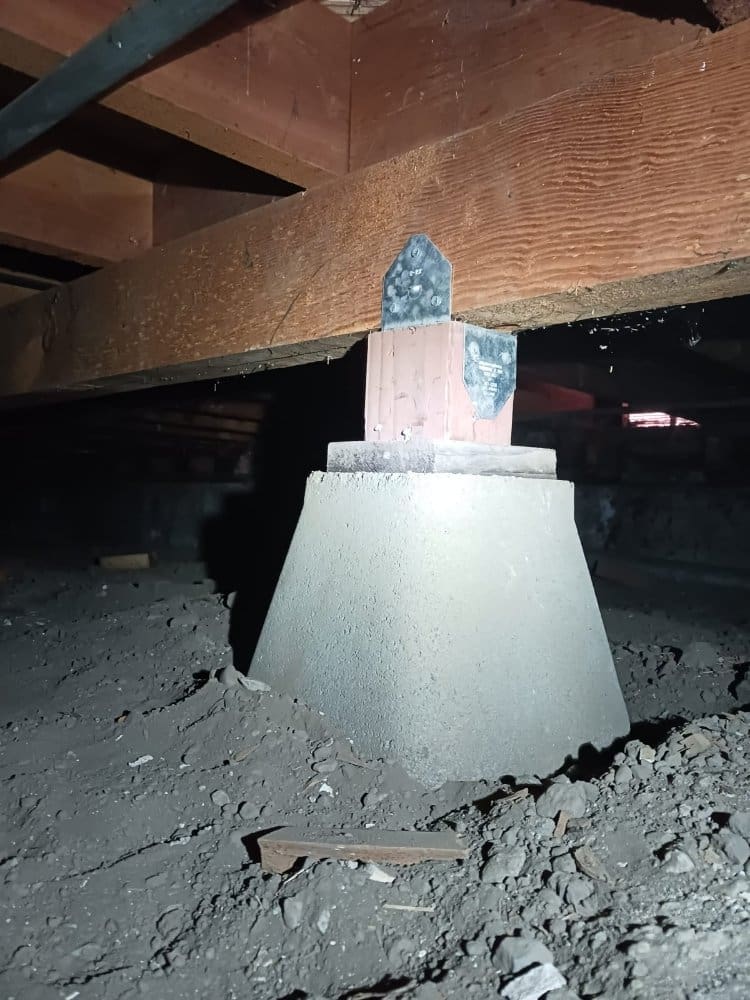
Our field protocol focuses on isolating mechanical floor framing sag from true deep-soil foundation sinking. During an inspection, we navigate crawl spaces to examine floor joists, post-and-pier supports, and concrete stem walls. We regularly find that sagging floor centers stem from dry rot or undersized girder beams, whereas perimeter drops indicate foundation sinking into shrinking clay subgrade.
Evaluating the visual findings requires applying precise structural criteria. If floor elevation variance across a fifteen-foot span exceeds 1 inch, underpinning intervention with steel piers is required to prevent structural framing failure. If variance remains under 0.5 inches and is localized around interior posts, adjusting support posts and installing subsurface drainage remediation will stabilize the structure without full pier underpinning.
Comparative Analysis of Bay Area Repair Techniques and Investment Costs
Selecting foundation repair techniques requires evaluating soil condition, load requirements, depth to competent bedrock, and floor slope deviation across the property. Solutions range from perimeter drainage systems for minor moisture issues to deep hydraulic underpinning and seismic bracing, with overall costs directly reflecting structural complexity and foundation depth.
Choosing the proper repair pathway requires balancing immediate budget constraints against long-term geotechnical performance. While surface patching offers low upfront expenses, applying cosmetic sealant to active settlement zones guarantees repeat failure. The detailed table below outlines typical scope requirements, structural repair techniques, and investment ranges across East Bay properties.
| Project Scope & Symptoms | Structural Techniques Implemented | Estimated Investment Range |
|---|---|---|
| Minor Slope & Drainage Issues (0.5 to 1 inch floor variance) | Exterior French drain installation, surface swales, crack injection | 5,000 USD to 12,000 USD |
| Moderate Settlement (1 to 2 inches slope, sticking doors) | Underpinning with 6 to 12 push piers, crawl space post replacement | 15,000 USD to 30,000 USD |
| Major Structural Settlement (2+ inches drop, stem wall fracture) | Helical pier installation (12+ piers), grade beam reconstruction | 32,000 USD to 65,000 USD |
| Seismic Retrofit (Pre-1980 unbolted raised foundation) | Foundation anchor bolts, cripple wall structural shear paneling | 3,000 USD to 9,000 USD |
Proper financial planning requires distinguishing between preventative maintenance and major structural restoration. Homeowners faced with active foundation sinking must prioritize load-bearing pier installation over interior cosmetic remodels. Attempting to renovate kitchens or bathrooms prior to leveling the home leads to cracked tile work and jammed cabinetry when structural work is performed later.
Seismic Upgrades and Mitigation Programs
Seismic retrofitting secures pre-1980 raised foundations to concrete footings using structural anchor bolts and cripple wall plywood shear paneling. This stabilization prevents home framing from shifting off concrete foundations during earthquake ground motion, protecting residential structural integrity across active San Francisco Bay Area fault lines.
Living on active earthquake faults makes structural bracing a necessity rather than an option. Many historic homes in Berkeley and Oakland sit unbolted on concrete footings or rely on weak wood cripple walls that can collapse under lateral shaking. Combining foundation stabilization with seismic upgrades ensures your home withstands both vertical soil settlement and horizontal earthquake forces.
Qualifying properties can offset retrofit expenses through financial assistance programs funded by state agencies. Homeowners can apply for financial assistance through the California Earthquake Authority Earthquake Brace + Bolt program, which offers grants up to 3,000 dollars for standard retrofits and up to 10,000 dollars for qualified income-eligible applicants. Evaluating repair trade-offs is critical: bolting a home to a foundation that is actively sinking will bind frame components, so sinking foundations must be stabilized with piers before performing seismic bracing.
Frequently Asked Questions
Can cosmetic drywall repair solve foundation settlement cracks?
No, cosmetic drywall patching only hides superficial evidence without stopping underlying foundation movement. If soil consolidation or expansion continues, drywall patches will re-crack within months. The root geotechnical settlement must be structurally remediated using piers or drainage control before repairing interior plaster or sheetrock.
How do seasonal wet and dry cycles affect clay soils beneath Bay Area homes?
Seasonal moisture fluctuations cause expansive clay soil to swell during rainy winters and shrink during dry summers. This volumetric expansion and contraction exerts immense hydraulic pressure on concrete footings, driving differential settlement over time. Installing effective perimeter drainage systems stabilizes soil moisture content and minimizes ground movement.
Does standard homeowners insurance cover foundation sinking in California?
Standard homeowners insurance policies specifically exclude structural damage caused by soil movement, settling, or earth expansion. Coverage is generally granted only if foundation failure directly results from a covered peril, such as a sudden indoor plumbing pipe burst. Supplemental earthquake policies or specialized riders are necessary to cover seismic-related foundation collapse.
What is the operational lifespan of steel underpinning piers?
Engineered steel helical and push piers have an operational design life exceeding 75 to 100 years. Manufactured from heavy-gauge galvanized steel, these systems resist soil corrosion while maintaining structural load transfer to competent strata. Professional pier installations typically include long-term manufacturer and installer warranties.
How do helical piers differ from steel push piers during foundation installation?
Helical piers feature screw blades welded to the central shaft and are mechanically threaded into soil until reaching target torque specifications. Steel push piers rely on hydraulic jacks using the structural weight of the building itself to drive smooth steel pipes down to bedrock. Helical piers are ideal for lighter structures or active slope stability, whereas push piers excel under heavy concrete foundations.
Sources
- Geology.com – Expansive Soil and Foundation Structural Hazards: https://geology.com/articles/soil/
- California Earthquake Authority – Residential Retrofit Programs & Grants: https://www.earthquakeauthority.com
Related Articles
House Sinking Covered By Insurance
What Is The Most Foundation Repair Can Cost?
Understanding Earthquake Effects On Foundations In Golden Bay’s Seismic Zones Near California
Foundation Repair Vs. Replacement: A Decision Guide For Bay Area Homeowners
What Are The Top-rated Foundation Repair Companies Near Me
The Role Of Helical Piers In Stabilizing Sloped Properties
People Also Ask
Yes, a sinking foundation can absolutely be fixed, but the method depends on the cause and severity of the settlement. For homes in Walnut Creek and Contra Costa County, common solutions include steel push piers or helical piers, which transfer the structure's weight to stable, load-bearing soil deep underground. Another option is slab jacking (or polyurethane foam injection), which lifts concrete slabs by filling voids beneath them. For a comprehensive understanding of your options, we recommend reading the article Hillside Foundation Stabilization: Homeowner's Guide to Permanent Safety (Without Guesswork). Golden Bay Foundation Builders always stresses that a professional soil analysis and structural inspection are critical first steps to ensure the chosen repair is permanent and safe.
A sinking foundation often shows clear warning signs. You might notice cracks in drywall, especially around door frames and windows, or doors that stick and no longer close properly. Outside, look for gaps between bricks or siding, and a visible separation between the chimney and the house. The most telling sign is a sloping or uneven floor, which you can check with a level. These symptoms indicate soil movement beneath your home, a serious structural issue. For a detailed look at financial solutions, our internal article House Sinking Covered By Insurance explains coverage options. Golden Bay Foundation Builders recommends immediate professional assessment if you observe these signs.
For foundation repair in Walnut Creek and Contra Costa County, the best time of year is typically during the dry summer and early fall months. This period offers stable soil conditions, which are crucial for a successful repair. Dry ground allows for proper excavation and ensures that concrete or pier systems cure effectively without interference from rain. Wet winter soil can shift and complicate the repair process, potentially leading to delays or compromised results. While emergency repairs can be done any time, planning your project for the dry season maximizes durability. For more detailed guidance, please refer to our internal article What Is The Best Time Of Year For Foundation Repair? which explores seasonal factors in depth.
For most homes in Walnut Creek and Contra Costa County, a small amount of foundation settling is normal, but the acceptable limit is generally under 1 inch of total differential movement. If you notice cracks wider than a quarter-inch in drywall or brick, doors sticking, or floors sloping more than 1 inch over 20 feet, this indicates excessive sinking that requires professional evaluation. The soil composition in our region can shift with seasonal moisture, but significant movement suggests a structural issue. Golden Bay Foundation Builders recommends reviewing our internal article How Much Foundation Sinking Is Acceptable? for detailed guidelines. Early intervention is key, as even minor sinking can worsen over time, leading to costly repairs. Always consult a licensed structural engineer for a precise assessment.
For a sinking foundation, the most common and effective solution is underpinning, which involves extending the foundation deeper to more stable soil. This is typically done using steel push piers or helical piers driven into load-bearing strata. The process requires a thorough geotechnical analysis to determine soil conditions and the proper depth for support. At Golden Bay Foundation Builders, we always recommend a professional evaluation before any repair, as the cause could range from soil consolidation to poor compaction. For a full breakdown of when repair is viable versus when a full replacement is necessary, we suggest reviewing our internal article titled Foundation Repair Vs. Replacement: A Decision Guide For Bay Area Homeowners. This guide provides critical insights for homeowners in Walnut Creek and Contra Costa County facing foundation settlement issues.