

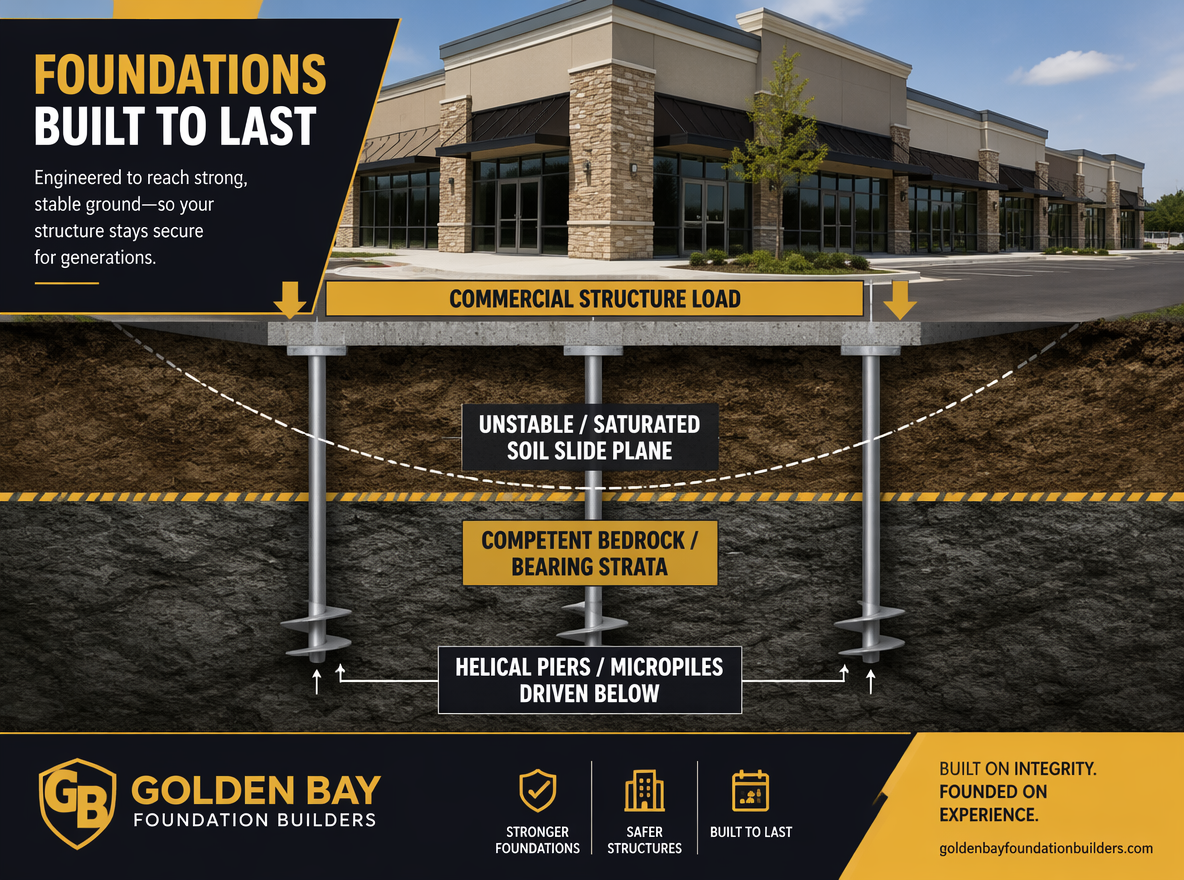
Geological Mechanics Driving Slope Instability in Oakland Hills Commercial Sites
Oakland commercial properties encounter severe foundation risks due to steep topography, clay-rich soil compositions, atmospheric river saturation, and active faulting. High groundwater levels generate excessive pore pressure that compromises soil bearing capacity, forcing deep foundation stabilization before lateral soil movement triggers catastrophic building failure.
Commercial real estate across the Oakland Hills, Montclair, Claremont corridor, and Piedmont Pines sits atop complex geological formations. Our engineering evaluations reveal that a substantial portion of eastern Oakland rests on the Franciscan Complex, a heterogeneous mix of sheared shale, fractured sandstone, and expansive clays. These native soils exhibit pronounced shrink-swell dynamics, expanding during wet months and contracting during dry spells to compromise perimeter footing support.
Extreme precipitation events delivered by atmospheric rivers rapidly saturate these clay strata. As un-drained water accumulates over subsurface rock layers, trapped pore water pressure reduces effective shear stress within the soil matrix. Under these conditions, overburdened subgrades begin acting like viscous fluids, driving downslope earth displacement against structural footings.
Additionally, proximity to the Hayward Fault Zone aggravates hillside stability. Tectonic creep and recurrent micro-seismic activity introduce extensive fracture networks within local rock masses. According to mapping published by the USGS Landslide Hazards Program, these rock fractures serve as high-permeability channels that accelerate deep subsurface water infiltration. Heavy commercial buildings, with substantial dead and live loads, exert extreme pressures that compound this instability when subgrades soften.
Early Warning Signs Indicating Impending Slope Shear and Foundation Distress
Detecting early indicators of structural displacement and slope shear allows facility managers to implement emergency underpinning protocols before irreversible failure occurs. Structural cracking, terrain fissuring, and unexplained subterranean water seepage signal rapid subgrade degradation, requiring immediate field engineering intervention to stabilize load-bearing grade beams.
We categorize property indicators into three distinct domains during emergency structural assessments:
- Exterior and Structural Indicators: Expanding diagonal shear fractures wider than 0.25 inches across concrete grade beams or tilt-up panels; separation between footings and perimeter slab aprons; binding elevator shafts; jammed emergency exit doors; visible tilting of cantilevered retaining structures.
- Geotechnical and Terrain Indicators: Arc-shaped tension cracking along asphalt parking areas or uphill slope faces; hummocky terrain slumping downslope; leaning utility poles, fence lines, or light standards; newly exposed soil along foundation grade lines.
- Hydrological Indicators: Sudden discharge of turbid groundwater near building perimeters; muddy runoff pooling against basement or retaining walls; active soil piping carrying fine sediments from under floor slabs.
Emergency Indicator Diagnostic Matrix
Categorizing slope and foundation indicators by root cause enables engineering teams to assign accurate urgency levels and prioritize structural interventions. Immediate shoring and dewatering take precedence when diagonal shear fractures appear, while tension cracking demands surface sealing and horizontal relief drilling to mitigate hydrostatic buildup.
| Indicator Category | Field Observation | Geotechnical Root Cause | Urgency Level | Emergency Engineering Intervention |
|---|---|---|---|---|
| Structural | Diagonal shear cracks (> 0.25 in) in grade beams or tilt-up walls | Differential settlement from subgrade bearing failure | Critical | Erect hydraulic shoring; drive helical or resistance piers to bearing strata |
| Geotechnical | Arc-shaped tension cracking in asphalt parking lots or upper slopes | Shear plane development initiating active slide movement | High | Seal fissures with impermeable membranes; initiate subgrade dewatering |
| Hydrological | Turbid water discharging from retaining wall weep holes | Trapped groundwater exerting high hydrostatic pressure | High | Hydro-jet internal drainage lines; drill horizontal relief wells |
| Architectural | Binding elevator cabs, jammed exit doors, gapping window frames | Slab tilting driven by localized downslope creep | Medium-High | Perform total-station laser survey; conduct geotechnical engineering review |
Structural Stabilization Technologies for Emergency Commercial Underpinning
Emergency foundation stabilization requires deep structural systems that bypass active shear zones to anchor into dense, competent strata. We utilize high-capacity helical piers, resistance push piers, drilled micropiles, post-tensioned tiebacks, and subgrade chemical grouting to arrest movement and transfer building loads into stable subterranean geological layers.
Helical Piers and Resistance Push Piers
Helical piers and resistance push piers offer rapid axial support for distressed commercial footings without requiring extensive perimeter excavation. Mechanically screwed or hydraulically driven through unstable surface soils, these piers transfer structural burdens directly onto dense bedrock or bearing soils with verified load-bearing capacities.
Helical piers feature high-strength steel shafts welded to helical bearing plates. We screw these deep into subgrades until installation torque values match designed axial support requirements. This technique excels on tight commercial perimeters where heavy excavation could destabilize surrounding slopes.
Resistance push piers utilize heavy-duty tubular steel sections driven hydraulically using the building’s structural dead weight as reaction resistance. Driving operations continue until the pier reaches solid end-bearing stratum or Franciscan bedrock. Once embedded, hydraulic manifold systems lift or lock off the foundation at target elevations.
Micropiles and Structural Tieback Anchors
Micropiles and tieback anchors provide robust resistance against extreme axial loads and lateral shear forces on steep hillside properties. High-strength steel casings and threaded bars are pressure-grouted into drilled rock sockets, creating reinforced columns capable of resisting severe ground movement and hydrostatic pressures.
Micropiles consist of small-diameter steel shafts advanced through loose slide debris into stable bedded rock. Pressure-injected cementitious grout bonds the steel casing directly to surrounding geological formations. This creates exceptional load transfer capabilities for heavy commercial structures situated over steep terrain.
Tieback anchors are installed diagonally through retaining walls or soldier piles into uncompromised rock formations. After curing, we post-tension these threaded steel rods using hydraulic jacks. This post-tensioning exerts holding forces that counteract lateral earth pressures acting on slope retention walls.
Soil Nailing Systems and Pneumatic Shotcrete
Soil nailing paired with pneumatic shotcrete creates high-integrity reinforced earth masses to lock steep hillside cuts against surface sliding. Slender steel reinforcing rods are grouted directly into slope faces, tied together with structural steel mesh, and encapsulated under high-pressure shotcrete to prevent slope degradation.
We deploy soil nailing when steep soil banks near commercial parking structures or access corridors show signs of shallow slumping. Steel nails are drilled on a downward incline across the predicted shear surface. Once grouted, the soil mass acts as a coherent retention block.
A heavy wire mesh or structural synthetic fiber matrix is attached over the nail heads. We then pneumatically apply thick structural shotcrete across the slope face. This seals the surface against rainfall infiltration and retains loose surface soils.
High-Density Polyurethane and Chemical Subgrade Grouting
Chemical grouting and high-density polyurethane injections deliver rapid subgrade densification and water displacement beneath compromised concrete slabs. Expanding closed-cell polymers fill subterranean voids, consolidate weak soils, and seal water channels prior to mechanical pier placement, ensuring stable base conditions during critical stabilization operations.
Hydrophobic polyurethane resins expand rapidly upon contact with subsurface moisture. As the polymer expands, it drives out trapped pore water and fills subterranean voids created by soil piping. This process increases subgrade bearing capacity within minutes.
Micro-fine cement slurries can also be pressure-injected into permeable gravel or fractured rock layers. This chemical permeation bonds loose soil particles together into a solid matrix. We often utilize grout injection as a preliminary stabilization step before executing deep piering.
Comparative Performance Matrix of Underpinning Systems
Selecting the correct structural stabilization method depends on installation speed, required load capacity, lateral shear demand, and site accessibility constraints. Combining deep vertical underpinning with lateral retaining tiebacks provides optimal long-term security, whereas shallow injection methods serve primarily for subgrade consolidation and temporary water displacement.
| Underpinning Method | Typical Installation Time | Ultimate Load Capacity Range | Primary Structural Function | Optimal Oakland Site Application |
|---|---|---|---|---|
| Helical Piers | 1 to 3 Days | 20 to 100+ Tons / Pier | Vertical Underpinning & Tension Resistance | Restricted-access footings in expansive clay subgrades |
| Resistance Push Piers | 1 to 2 Days | 30 to 75 Tons / Pier | End-Bearing Axial Structural Support | Heavy concrete slab & grade beam foundations over bedrock |
| Drilled Micropiles | 2 to 5 Days | 50 to 200+ Tons / Pile | Axial Capacity & High Lateral Shear Resistance | Steep hillside rock slopes beneath high-load commercial facilities |
| Soil Nailing & Shotcrete | 3 to 7 Days | Mass Slope Surface Retention | Shear Mass Consolidation & Erosion Control | Exposed cut slopes adjacent to parking structures & access lanes |
| Polyurethane Injection | 1 Day | Subgrade Densification & Void Filling | Water Displacement & Subsurface Sealing | Under-slab void filling & emergency subgrade consolidation |
Field Operations: Real-World Case Studies in the East Bay
Real-world field execution requires custom structural engineering adaptations to resolve complex geotechnical emergencies under adverse weather conditions. Our firm successfully mitigated active movement on two severe hillside commercial sites in Oakland, protecting structural assets and preserving business continuity through rapid emergency underpinning protocols.
Case Study 1: Mid-Rise Office Facility in Claremont Corridor
An intense winter storm triggered 1.8 inches of rapid foundation movement at a three-story office complex along the Claremont corridor. Trapped water behind an unvented retaining wall elevated hydrostatic pressure, inducing shear failure within the upper clay strata and threatening complete structural collapse of the lower grade beams.
Our emergency engineering team mobilized to the site within four hours of notification. We deployed modular hydraulic shoring towers beneath structural beams to redistribute live and dead loads. Simultaneously, we drilled horizontal relief wells through the retaining structure to relieve hydrostatic head.
To achieve permanent stability, we installed 28 resistance push piers through the active slide plane into competent Franciscan bedrock at average depths of 38 feet. Using multi-point hydraulic lifting manifolds, we locked off the foundation, arresting movement and restoring structural alignment. Commercial office operations on upper floors continued without interruption.
Case Study 2: Logistics Warehouse Complex Near Hayward Fault
Severe subterranean soil piping washed out structural subgrade support beneath a commercial loading dock complex situated near the Hayward Fault zone. High-velocity groundwater flowing through fault fractures created large voids under concrete footings, leaving heavy tilt-up wall panels completely unsupported during active precipitation.
We initiated a two-phase emergency intervention to restore subgrade support. First, we injected high-density closed-cell polyurethane resin into the subterranean voids to displace flowing groundwater and consolidate the remaining soil mass. This sealed the active erosion channel within five hours.
Second, we installed a perimeter network of drilled micropiles integrated with post-tensioned tieback anchors driven deep into dense subterranean rock. According to seismic evaluation guidelines maintained by the California Geological Survey, foundation retrofits in high-seismic fault corridors must withstand dynamic ground motions. Our micropile network secured the facility against combined lateral slope movement and dynamic seismic loads.
Sequential Emergency Response Protocol During Extreme Precipitation Events
When severe storms threaten hillside commercial infrastructure, executing a disciplined sequence of site actions mitigates risk and prevents catastrophic structural collapse. Our standardized emergency protocol prioritizes immediate safety containment, aggressive surface water management, load redistribution, deep foundation installation, and long-term slope retention.
- Immediate Site Hazard Containment and Dynamic Monitoring: Evacuate affected bay zones and establish safe work perimeters. We install total-station tiltmeters and subterranean inclinometers to track realtime slope movement rates.
- Surface Water Management and Subsurface Dewatering: Secure impermeable plastic membranes over surface tension cracks to halt rain infiltration. Deploy high-capacity trash pumps and drill horizontal relief drains to vent trapped hydrostatic head behind structures.
- Deployment of Temporary Structural Load Redistribution Shoring: Position modular hydraulic steel shore towers under sagging grade beams and tilt-up panels. This stabilizes dead and live structural loads, ensuring worker safety during subsequent underpinning operations.
- Installation of Deep High-Capacity Underpinning Elements: Advance resistance push piers or drilled micropiles through active shear planes into underlying competent rock formations. Lock off pier capacities using hydraulic manifold systems calibrated to exact building design loads.
- Permanent Slope Retention and Subsurface Drainage Construction: Construct permanent slope retention barriers using post-tensioned tiebacks, soil nails, and structural shotcrete. Install deep subdrainage systems and perforated collection pipes to safely route groundwater to municipal storm drains.
Regulatory Frameworks, Oakland Permitting, and Building Codes
Navigating Oakland municipal regulations and state safety mandates is essential during emergency hillside structural repairs. While local building codes enforce strict seasonal grading restrictions, emergency stabilization projects addressing imminent structural failure qualify for expedited permitting exemptions when executed in compliance with California structural standards.
The City of Oakland Planning and Building Department enforces a Wet Weather Grading Moratorium between October 15 and April 15 under Oakland Municipal Code OMC 15.04.3.2065. However, emergency stabilization required to protect life safety or prevent property destruction receives immediate administrative exemptions. We submit geotechnical engineering recommendations and shoring calculations to obtain over-the-counter emergency authorization.
All structural repair designs must satisfy California Building Code Title 24 guidelines for Seismic Design Categories D through F. This ensures installed foundation elements withstand both static earth pressures and dynamic ground motion along the nearby Hayward Fault.
Furthermore, deep excavation and underpinning operations must comply strictly with safety standards established under OSHA Trenching and Excavation Safety Standards (29 CFR 1926 Subpart P). Adhering to these federal workplace regulations protects site personnel from cave-ins and structural collapse during deep underpinning activities.
Protecting Commercial Asset Value and Mitigating Operational Risk
Proactive foundation stabilization protects multi-million US Dollar commercial assets from severe structural damage, long-term operational disruption, and extreme financial exposure. Immediate structural intervention preserves tenant operations, maintains building insurability, and eliminates catastrophic liability risks associated with uncontrolled slope failure across adjacent urban land.
Unaddressed slope instability can lead to municipal red-tagging, rendering commercial facilities uninhabitable and halting revenue streams. Executing deep underpinning before total slope shear allows business operations to continue safely during repair activities.
Proactive geotechnical stabilization also satisfies commercial mortgage covenants and insurer mandates. Demonstrating proactive structural risk mitigation prevents policy cancellation and preserves overall commercial real estate valuations in vulnerable hillside markets.
Frequently Asked Questions
How quickly can emergency foundation stabilization be deployed on an Oakland commercial property?
Emergency field crews can mobilize to an Oakland commercial site within two to twelve hours of receiving an urgent request. Immediate site stabilization—including surface water diversion, protective slope tarping, and hydraulic shoring—is typically executed on Day 1. Deep piering or micropile drilling begins within 24 to 48 hours once rapid geotechnical assessments and emergency city permits are finalized.
What is the difference between helical piers and micropiles for hillside foundation stabilization?
Helical piers are screwed mechanically into stable soil zones, whereas micropiles are cased steel shafts drilled and pressure-grouted directly into dense rock formations. Helical piers excel at supporting vertical loads in expansive clay soils without requiring heavy excavation. Micropiles provide superior lateral shear capacity and high axial support when penetrating boulder-laden subgrades or fractured bedrock on steep slopes.
How do heavy winter storms and atmospheric rivers trigger Oakland landslides around commercial structures?
Atmospheric rivers deliver rapid, concentrated rainfall that overwhelms natural drainage pathways and fully saturates surface soils. Trapped groundwater above non-porous rock layers builds hydrostatic pore pressure that reduces soil shear strength. This loss of internal friction converts upper soil masses into fluid slides that move downhill against foundation footings.
Does commercial property insurance cover slope stabilization and foundation repair caused by mudslides?
Standard commercial property insurance policies typically exclude loss or damage caused by earth movement, landslides, or mudslides. Building owners generally require a specialized Earth Movement Endorsement or a Difference in Conditions policy to cover landslide-related foundation repairs. However, emergency shoring or dewatering may be covered if slope failure resulted directly from an insured sudden plumbing rupture or covered water event.
What temporary measures can be taken while awaiting heavy piering equipment?
Facility managers can install temporary hydraulic shoring jacks under sagging grade beams while sealing slope tension cracks with impermeable plastic tarps. Placing sandbag channels directs surface runoff away from foundation footings and prevents further soil saturation. Additionally, clearing blocked storm drains and hydro-jetting retaining wall weep holes helps vent trapped groundwater to reduce hydrostatic pressure.
Sources
- City of Oakland Planning and Building Department: https://www.oaklandca.gov/departments/planning-and-building
- USGS Landslide Hazards Program: https://www.usgs.gov/programs/landslide-hazards
- California Geological Survey: https://www.conservation.ca.gov/cgs
- OSHA Trenching and Excavation Safety Standards: https://www.osha.gov/trenching-excavation


Comments are closed