

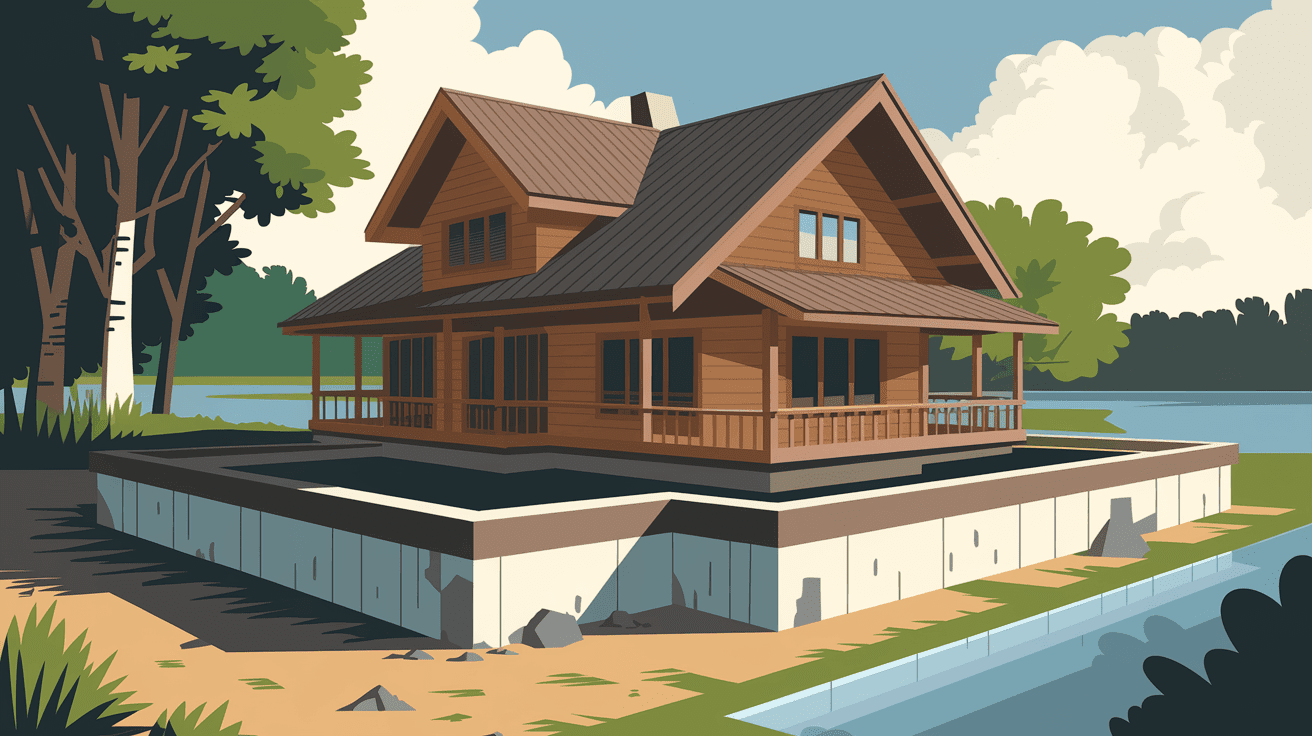
Core Architectural Distinctions Between Stem Walls and Foundation Walls
Stem walls and foundation walls differ primarily in depth, structural load transfer, and spatial utilization beneath the building frame. Stem walls elevate structures via short concrete walls attached to spread footings, creating crawl spaces. Foundation walls extend deep underground to retain lateral soil loads while forming full basements or submerged structural enclosures.
When we evaluate underlying support systems across Northern California, we treat stem walls and full foundation walls as structurally distinct choices rather than interchangeable options. A stem wall acts as a perimeter ribbon that bridges the gap between shallow footing bases and the raised ground floor. This configuration elevates the wood sill plates safely above ground-level moisture, surface runoff, and soil pests.
Conversely, a full foundation wall acts both as a vertical load-bearing structure and an earth-retaining bulkhead. According to design criteria established by the American Society of Civil Engineers (ASCE), structural elements exposed to below-grade earth pressures must be sized to withstand intense hydrostatic and soil-expansive forces. Foundation walls achieve this resilience through continuous reinforced poured concrete or fully grouted concrete masonry units (CMU).
Choosing between these foundational types dictates how your home interacts with local seismic activity and sub-surface moisture. Stem walls rely on perimeter footings and internal pier supports to manage gravity loads, while full foundation walls distribute weight across a deeper subterranean footprint.
Structural Mechanics and Benefits of Stem Wall Systems
Stem wall systems function by separating the structural concrete pour into sequential elements, connecting shallow reinforced concrete footings to vertical walls that extend above finished grade. This elevated design protects floor framing from soil-borne moisture, accommodates uneven ground, and minimizes earth excavation requirements during initial site preparation.
In traditional stem wall construction, we execute a multi-step pour sequence that begins with continuous concrete spread footings below the regional frost line. Once the footings cure, vertical concrete walls or masonry blocks are tied into the base using steel rebar dowels. This two-part construction methodology creates a hollow envelope between the ground and the raised subfloor.
We frequently specify stem wall systems due to their specific operational advantages in varied topography:
- Raised crawl space access permits straightforward routing, inspection, and maintenance of plumbing, electrical, and HVAC infrastructure.
- Elevation above grade provides vital protection against localized flash floods and surface water infiltration.
- Modular height adjustments allow the stem wall to absorb natural terrain contours on gently sloping building sites without deep excavation.
- Separating the footing pour from the stem pour minimizes structural cracking caused by early concrete thermal shrinkage.
Despite these benefits, unreinforced or poorly ventilated stem walls present operational failure modes in high-moisture environments. Without adequate cross-ventilation, moisture accumulating within the crawl space causes fungal wood decay and efflorescence on concrete surfaces. Furthermore, when unanchored stem walls experience localized soil settlement, differential sagging along the mudsill can warp upper structural framing.
Structural Engineering and Load Capabilities of Foundation Walls
Foundation walls operate as deep, load-bearing vertical barriers engineered to resist both severe downward structural loads and intense lateral hydrostatic soil pressures. Extending down to deep bearing strata, these reinforced monolithic poured or masonry walls form complete underground living zones or tall utility spaces within the building envelope.
The construction of a full foundation wall requires extensive site excavation down to the planned basement slab elevation. We pour thick, continuous perimeter footings and then construct full-height vertical walls—typically eight to ten feet tall—directly tied into the base with heavy-duty rebar matrices. Guidelines published by the Federal Emergency Management Agency (FEMA) emphasize that full foundation walls must be designed to withstand severe hydrostatic pressures and soil expansion to prevent structural bowing.
Full foundation walls deliver superior load distribution and space utilization under specific architectural requirements:
- Enclosed underground profiles generate usable interior square footage for living areas, mechanical rooms, or storage.
- Subterranean wall placement leverages the natural insulating properties of earth to stabilize interior structural temperatures.
- High structural mass provides substantial resistance against wind uplift and lateral shear forces during extreme storm events.
However, full foundation walls remain susceptible to lateral earth pressures if backfilling occurs before the concrete reaches full design strength. Hydrostatic pressure from trapped groundwater can push foundation walls inward, leading to vertical shear cracks and water entry. Proper exterior membrane waterproofing, continuous footing drains, and controlled gravel backfilling are mandatory engineering controls for every installation.
Comparative Analysis: Stem Walls vs Full Foundation Walls
Evaluating stem walls against deep foundation walls requires analyzing structural performance, environmental adaptability, excavation demands, and overall financial expenditure. While stem walls provide cost-effective elevation on sloped or flood-prone terrain, full foundation walls deliver superior structural resistance and subterranean livable area at higher construction investments.
The structural trade-offs between stem walls and foundation walls depend heavily on site geology, local moisture levels, and budget constraints. Stem walls require significantly less excavation and total concrete volume, making them a efficient selection for flat or gently rolling terrain. Conversely, full foundation walls demand extensive soil displacement and heavy internal rebar reinforcement, resulting in higher material and labor investments.
| Engineering Parameter | Stem Wall Foundation System | Full Foundation Wall System |
|---|---|---|
| Excavation Depth | Shallow (typically 12 to 36 inches below grade) | Deep (typically 8 to 10 feet below grade) |
| Primary Structural Function | Elevates structure and supports perimeter loads | Retains earth and bears full vertical/lateral loads |
| Subfloor Environment | Ventilated crawl space or backfilled slab | Full subterranean basement or finished room |
| Hydrostatic Resistance | Moderate (designed for surface water management) | High (engineered to resist lateral groundwater pressures) |
| Average Installation Investment | 8,000 to 22,000 US dollars | 25,000 to 65,000 US dollars |
| Thermal Insulation Efficiency | Moderate (requires crawl space floor insulation) | High (protected by surrounding thermal earth mass) |
| Seismic Shear Resistance | Excellent when retrofitted with cripple wall plywood | Exceptional due to continuous monolithic wall mass |
The economic choice often hinges on total square footage goals and topographical site constraints. While stem walls reduce upfront site clearance costs, foundation walls convert sub-grade structural volume into usable property area.
Real-World Field Challenges and Engineering Solutions
Addressing foundation degradation in Northern California requires field-tested structural solutions tailored to complex geological faults, steep topography, and expansive soil profiles. Our engineering interventions successfully restore structural integrity to failing stem walls and bowed foundation walls across challenging Bay Area residential and commercial job sites.
In Walnut Creek, we inspected a two-story home where highly expansive montmorillonite clay soil caused severe structural distress. The swelling soil generated 2.5 inches of differential heave across the home’s 1,200-square-foot stem wall crawl space, causing extensive diagonal cracking in the unreinforced concrete stems. To resolve this, we excavated perimeter trenches down to stable bedrock, installed structural steel push piers beneath the footings, retrofitted the stem walls with structural carbon-fiber grid straps, and installed a closed drainage system to stabilize soil moisture levels.
In another complex project along the Berkeley Hills, we addressed a 70-year-old foundation wall on a 28-degree slope that was bowing inward by nearly 3.5 inches. Hydrostatic pressure from seasonal runoff combined with downhill soil creep had severely compromised the wall’s structural integrity, creating a risk of shear failure during seismic movement. We temporarily shored the house with steel I-beams, excavated the retaining soil, drilled heavy-duty helical tie-back anchors 25 feet into stable rock, poured a reinforced concrete face wall tied via epoxy-anchored rebar dowels, and installed an active exterior drainage matrix.
These field cases illustrate that foundation success depends on matching the structural repair approach directly to site geology:
- Expansive clay heave requires deep piering systems that bypass active soil zones entirely.
- Hydrostatic pressure along slopes necessitates lateral tie-back anchors paired with continuous drainage pathways.
- Unreinforced concrete walls require high-tensile composite carbon fiber overlays to restore structural capacity without adding heavy weight.
Site-Specific Selection Framework for Northern California Properties
Selecting between a stem wall and a full foundation wall depends upon precise geotechnical evaluations, localized slope topography, flood zone designations, and budget parameters. Property owners must analyze soil plasticity indices, fault proximity, and structural square footage requirements to implement the optimal foundation geometry for long-term stability.
Geotechnical data provided by the United States Geological Survey (USGS) indicates that clay soils across Northern California experience dramatic volumetric changes between wet and dry seasons. When building on expansive clay, prioritizing deep foundation walls anchored below the seasonal moisture zone prevents foundation movement. Conversely, if your site features stable bedrock with significant slope contours, stem walls offer a flexible method to step the foundation up the hill efficiently.
To select the correct foundation design for your property, execute the following step-by-step engineering decision matrix:
- Obtain a comprehensive geotechnical soil report to determine the soil plasticity index, allowable soil bearing capacity, and seasonal water table depth.
- Review local municipal flood maps; if the building envelope sits within a designated high-water flood plain, select a stem wall system equipped with engineered flood vents.
- Calculate slope angles across the building footprint; select stepped stem walls for slopes between 10 and 25 degrees to minimize excavation costs.
- Evaluate seismic hazard zones; if the property lies near an active fault line, ensure any selected foundation wall includes dense rebar grids and continuous shear transfer anchor bolts.
- Perform an investment-to-value analysis comparing the higher upfront cost of a basement foundation wall against the added value of subterranean square footage.
By adhering to this conditional selection process, property owners avoid common foundation failure modes while ensuring full compliance with California building standards.
Frequently Asked Questions
Frequently Asked Questions
How do stem walls handle Bay Area expansive clay soils compared to full foundation walls?
Stem walls isolate framing from surface heave but remain vulnerable to lateral shifting unless anchored deeply into stable soil strata. Full foundation walls resist expansive clay movement through higher mass and continuous lateral reinforcement, provided deep excavation bypasses active surface moisture zones. In areas with reactive clay, stem walls typically require deep steel piers to prevent seasonal differential movement.
What are the primary warning signs that a stem wall or foundation wall requires repair?
Visible diagonal cracking, horizontal shear displacement, sticking doors, or unlevel interior floors indicate significant foundation distress. Stem wall failures frequently present as cracked crawl space vents or sagging floor joists above the mudsill. Bowing inward along basement surfaces usually points to excessive hydrostatic pressure pressing against full foundation walls.
Can a stem wall foundation be converted or retrofitted into a full foundation wall basement?
Converting a stem wall crawl space into a full basement is technically feasible through underpinning and excavation, though it involves extensive structural engineering. The process requires temporary structural shoring, sequential excavation beneath existing footings, and pouring continuous reinforced concrete walls to establish new subterranean vertical boundaries. This procedure demands significant financial investment and precise moisture control engineering.
How do local seismic codes impact the choice between stem walls and foundation walls in California?
California seismic codes require continuous lateral shear reinforcement, seismic anchor bolting, and strict uplift resistance for both stem walls and deep foundation walls. Stem walls with short wood cripple walls must be reinforced with structural plywood sheathings and heavy hold-down hardware to resist horizontal earthquake shaking. Deep foundation walls must incorporate continuous horizontal and vertical rebar lattices to resist severe lateral ground acceleration without cracking.
What is the typical installation cost difference between stem walls and continuous foundation walls?
Stem wall installations generally cost between 8,000 US dollars and 22,000 US dollars, whereas full foundation walls range from 25,000 US dollars to 65,000 US dollars or more. The cost variance stems directly from deeper excavation requirements, increased concrete volume, higher steel rebar quantities, and specialized waterproof membrane installations associated with full basement walls. Site accessibility and localized soil conditions also influence final pricing metrics.
Sources
- American Society of Civil Engineers (ASCE) – Risk Assessment and Mitigation for Expansive Soils: https://www.asce.org/
- Federal Emergency Management Agency (FEMA) – Design Guide for Improving Critical Facility Safety from Flooding (FEMA 543): https://www.fema.gov/
- United States Geological Survey (USGS) – Overview for Design of Foundations on Expansive Clays: https://www.usgs.gov/
Related Articles
What Type Of Foundation Repair Is Best?
How To Choose The Right Foundation For Your House
Comprehensive Guide To Preventing Mold Growth From Foundation Water Intrusion
Bay Area Foundation Maintenance: A Seasonal Guide For Homeowners
The Homebuyer’s Guide To Evaluating Foundation Issues In The Bay Area
How To Detect Hidden Foundation Issues Behind Finished Walls
How To Read A Foundation Report?
Bay Area Retaining Walls: How They Protect Your Foundation
People Also Ask
The primary difference between a foundation wall and a stem wall lies in their structural role and placement. A foundation wall is a load-bearing component that directly supports the weight of the structure above, often extending from the footing to the floor level. In contrast, a stem wall is a type of foundation wall that rises from the footing to just below the floor framing, creating a crawl space. Stem walls are common in areas with expansive soils, like parts of Contra Costa County, as they elevate the structure. For homeowners in Walnut Creek, understanding this distinction is crucial during inspections. For deeper insights, refer to our internal article Spotting Structural Red Flags During Home Inspections: A Bay Area Homeowner’s Definitive Guide, which covers key structural details. Golden Bay Foundation Builders recommends consulting a professional to evaluate your specific foundation type.
Stem wall foundations have several drawbacks to consider. They are more expensive and labor-intensive to construct than a simple slab, requiring significant excavation, formwork, and concrete. The interior crawl space, while useful for access, can become a haven for moisture, pests, and mold if not properly sealed and ventilated. This often necessitates additional costs for vapor barriers and insulation. Furthermore, stem walls are susceptible to cracking from soil movement or frost heave, which can compromise the structure. For homeowners in Walnut Creek, Golden Bay Foundation Builders recommends reading Crawl Space Foundation: The Complete Guide for Homeowners and Builders for a thorough comparison of foundation types and their long-term maintenance needs.
A stem wall is commonly referred to as a "foundation stem wall" or simply a "stem wall foundation." In the construction industry, it is also sometimes called a "poured concrete stem wall" when it is cast in place. This type of foundation is essentially a vertical concrete wall that sits on top of a footing and supports the structure above, creating a crawl space. For homeowners in Walnut Creek and Contra Costa County, understanding this term is crucial when planning a new build. At Golden Bay Foundation Builders, we always recommend reviewing our internal article How to Choose the Right Foundation for Your House to ensure you choose the right foundation type for your specific soil and site conditions.
The two primary types of foundation walls are poured concrete and concrete block (CMU). Poured concrete walls are created by erecting forms and pouring liquid concrete into them, resulting in a monolithic, seamless wall that is very strong and resistant to water intrusion. Concrete block walls are built by stacking hollow or solid masonry blocks and reinforcing them with steel rebar and mortar. For homeowners in Walnut Creek and Contra Costa County, choosing between these options depends on soil conditions, budget, and structural needs. For a deeper comparison of modern alternatives, we recommend reading our internal article titled ICF vs. Poured Concrete Foundations: Which is Best for Your Home?. Golden Bay Foundation Builders can help you evaluate which system provides the best long-term performance for your specific property.