

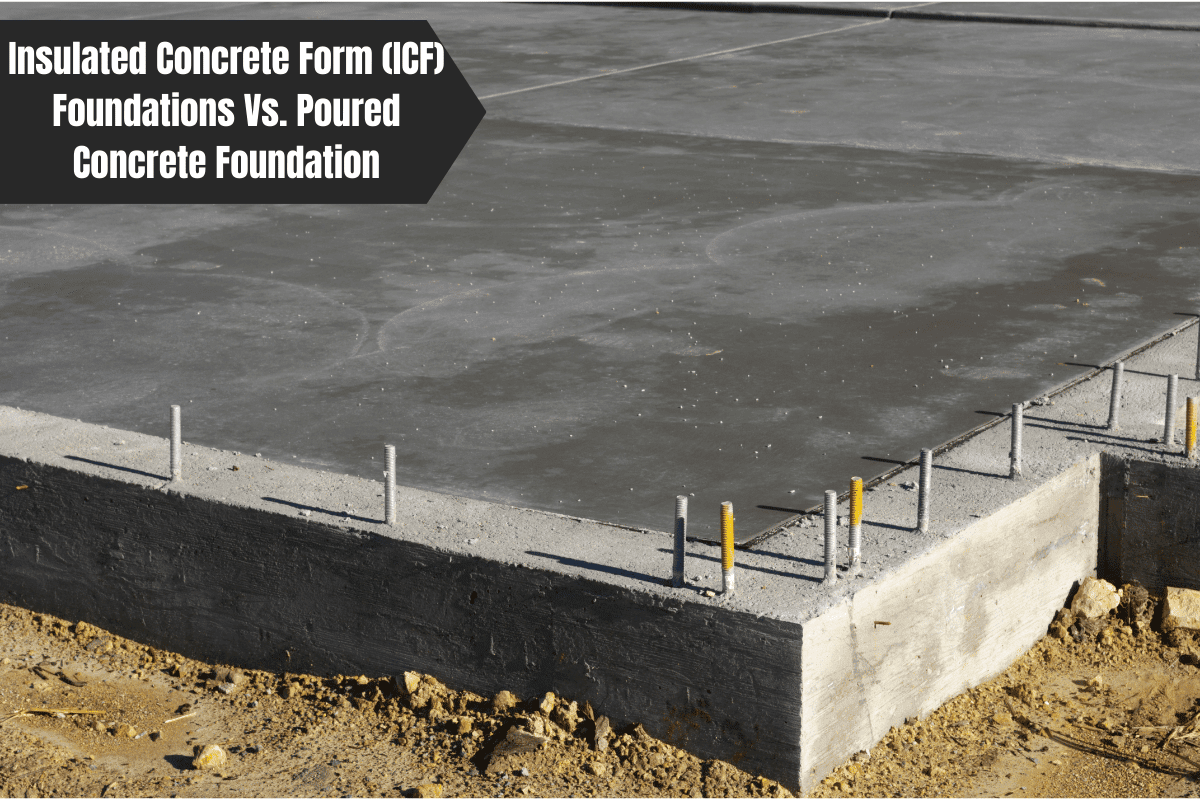
For most homeowners who plan to finish their basement or prioritize long-term energy savings, an Insulated Concrete Form (ICF) foundation is the superior choice. An ICF foundation costs roughly 15 percent more upfront than a standard poured concrete wall, but it eliminates the hidden costs of framing, insulating, and vapor-proofing a conventional foundation. When those hidden costs are added to a poured concrete builder’s quote, the finished ICF wall is typically 10 to 20 percent less expensive. If your budget is extremely tight and you do not intend to finish the basement, a properly waterproofed poured concrete foundation remains a reliable option.
What Are ICF and Poured Concrete Foundations?
Insulated Concrete Forms (ICF) consist of hollow, interlocking expanded polystyrene (EPS) foam blocks that are stacked, reinforced with steel rebar, and filled with concrete. The foam remains in place permanently, providing two continuous layers of insulation—one on the interior and one on the exterior—creating a monolithic concrete wall that is structurally strong, thermally efficient, and moisture-resistant.
Poured Concrete Foundations are constructed by setting up temporary aluminum or wood forms on a footing, placing steel reinforcement between the forms, and pouring concrete into the cavity. After the concrete cures, the forms are stripped away, leaving a bare concrete wall that must later be insulated and waterproofed as separate steps.
ICF vs. Poured Concrete: A Side-by-Side Comparison
| Feature | ICF Foundation | Poured Concrete Foundation |
|---|---|---|
| Upfront Cost | 10 to 15 percent higher than poured concrete | Lower initial cost |
| Finished Cost (with drywall-ready basement) | Often 10 to 20 percent lower than poured concrete | Higher after adding framing, insulation, and vapor barrier |
| Insulation (R-Value) | R-22 to R-28 continuous insulation | R-1 to R-2 (uninsulated) |
| Energy Code Compliance (2026 IRC) | Meets or exceeds without additional work | Requires framing and insulation to meet code |
| Moisture Resistance | EPS foam breaks capillary action; wall stays warm, preventing condensation | Concrete is porous; requires separate waterproofing and vapor barriers |
| Compressive Strength | Up to 50 percent higher due to wet-cure environment | Standard strength; potential micro-cracking from rapid drying |
| Seismic Performance | Excellent; continuous concrete core with foam ductility | Good when properly reinforced, but less ductile |
| Installation Speed | Slower initial stacking, but insulation is integral | Faster pour, but additional trades needed later |
| Customization | Limited to manufacturer block shapes; curved walls possible with specialty blocks | Unlimited shapes, angles, and curved walls |
| Pest Resistance | Requires physical barrier below grade against termites | Not a concern |
| Interior Wall Finishing | Furring strips or metal track required for drywall | Drywall can be mounted on framing attached to concrete |
| Air Tightness | Monolithic construction eliminates infiltration; minimal air leakage | Requires separate air sealing measures |
| Sound Attenuation | 55+ STC rating; excellent sound isolation | Low sound isolation without additional framing and insulation |
Cost Breakdown: The Numbers You Need to Know
Upfront Foundation Costs
For a typical 1,600-square-foot foundation with 160 linear feet of 9-foot-high wall:
| Item | Poured Concrete | ICF Foundation |
|---|---|---|
| Foundation Quote | 38,000 USD | 45,000 USD |
| Framing (2×4 interior walls) | 4,500 USD | Included |
| Insulation (fiberglass or spray foam) | 5,500 USD | Included |
| Vapor Barrier | 1,500 USD | Included |
| Electrical Labor Premium | 1,000 USD | Included |
| Total “Ready to Drywall” Cost | 50,500 USD | 45,000 USD |
Source: BlueGreen Building Concepts, 2026
The Hidden Costs of a Poured Concrete Foundation
When a builder provides a quote for a poured concrete foundation, the number typically reflects only the concrete work. To turn that cold, damp concrete wall into a finished living area, you must hire separate contractors to:
-
Frame a 2×4 wall around the entire perimeter.
-
Install insulation to meet the 2026 IRC requirement of R-15 continuous or R-19 cavity.
-
Apply a vapor barrier to control moisture.
-
Drill through studs for electrical wiring.
These additional steps can add 14,000 USD or more to the project, erasing the apparent savings of a poured concrete foundation.
Long-Term Savings with ICF
ICF foundations reduce energy consumption year-round. A study commissioned by the Portland Cement Association found that homes built with ICF exterior walls consume 32 to 71 percent less energy for heating and cooling compared to comparable wood-frame houses. The NAHB Research Center confirmed that ICF homes used 10 percent less cooling energy and 13 percent less heating energy than conventionally framed homes. In real-world terms, ICF homeowners often report 20 to 30 percent lower heating and cooling bills compared to uninsulated poured concrete basements, with some studies documenting energy savings of up to 58 percent annually compared to traditional wood-frame construction.
Insulation and Energy Efficiency
R-Value Comparison
| Foundation Type | Typical R-Value |
|---|---|
| Uninsulated Poured Concrete (8 inches thick) | R-1 to R-2 |
| ICF Wall (EPS foam on both sides) | R-22 to R-28 |
| ICF Wall (Nudura One Series) | R-24 minimum |
| ICF Wall (with thicker EPS options) | R-40 to R-48 |
An uninsulated poured concrete wall has roughly the same insulating value as a single pane of glass. Eight inches of uninsulated concrete provides an R-value of only 1.35. In contrast, an ICF wall provides continuous insulation that eliminates thermal bridges and keeps basement wall surfaces warm, preventing condensation and mold growth. The combination of continuous insulation and the thermal mass of the concrete core allows ICF buildings to maintain remarkably stable indoor temperatures with minimal energy input.
Building Code Compliance
The 2026 International Residential Code (IRC) requires basement walls to be insulated to R-15 continuous or R-19 cavity, depending on climate zone. In colder climate zones (5, 6, 7, 8, and Marine Zone 4), the minimum is R-15. A bare poured concrete wall does not meet this standard and must be retrofitted with framing and insulation. An ICF foundation meets or exceeds these requirements from day one, saving time and labor.
Moisture Management and Waterproofing
Concrete is naturally porous. In a standard poured concrete foundation, capillary action draws groundwater through the concrete and releases it into the basement as water vapor, causing that familiar “musty basement” smell. Even a spray-applied dampproofing coating does not stop water vapor migration.
An ICF foundation breaks this cycle in two ways:
-
The exterior foam layer prevents wet soil from touching the concrete directly.
-
The interior foam keeps the wall surface above the dew point, so condensation cannot form. No condensation means no food source for mold.
ICF walls act as a solid vapor retarder, pushing the dew point to the outside of the wall assembly. The EPS foam resists liquid water and does not support mold growth, while the concrete core minimizes temperature fluctuations to keep the basement drier, warmer, and healthier.
Both foundation types still require a waterproofing membrane on the exterior. For ICF, a liquid-applied, elastomeric membrane designed to bond with polystyrene is recommended. A drainage board should be installed over the membrane to protect it during backfill.
Structural Strength and Seismic Performance
The Wet-Cure Advantage
Concrete does not dry—it cures through a chemical reaction that requires water. When poured concrete is left in aluminum forms for only 24 to 48 hours and then exposed to air, it often dries too quickly. This rapid moisture loss can cause surface crazing and micro-cracking, which reduce the wall’s eventual strength.
ICF forms stay in place permanently, holding moisture in the concrete for weeks. This “wet cure” environment allows the concrete to reach its full design strength and often exceed it. A controlled study found that concrete cured within ICFs exhibited a 50 percent increase in compressive strength at 56 days compared to conventionally cured concrete. The ICFA has confirmed similar results in testing overseas, documenting a general strength gain of approximately 60 percent when using ICF systems.
Seismic Resilience
For homes in earthquake-prone regions such as Contra Costa County and the greater San Francisco Bay Area, seismic performance is critical. ICF construction meets resilient design standards, including ICC 500, FEMA, and NBC criteria for storm shelters and post-disaster buildings. When designed with site-specific engineering—including tighter rebar spacing in high Seismic Design Categories—ICF foundations offer superior ductility and lateral force resistance compared to conventional poured concrete walls. ICF walls distribute seismic loads effectively through their continuous reinforced concrete core, and the monolithic structure dissipates seismic energy more efficiently than segmented construction methods.
Construction Speed and Complexity
| Phase | Poured Concrete | ICF Foundation |
|---|---|---|
| Form Setup | Aluminum forms assembled quickly by experienced crew | Foam blocks stacked manually; requires precision leveling |
| Concrete Pour | Single pour; forms stripped after 24 to 48 hours | Pour into foam blocks; foam stays in place |
| Insulation Installation | Separate contractor must apply insulation after curing | Insulation is integral—no additional step |
| Waterproofing | Applied to bare concrete | Applied to foam surface with compatible membrane |
| Finishing (Drywall) | Requires framing, insulation, vapor barrier | Furring strips embedded in foam; drywall screws into strips |
| Total Trades Required | 4 to 5 (concrete, framing, insulation, vapor barrier, electrical) | 2 (concrete, drywall) |
Poured concrete is faster for the initial concrete crew, but the project timeline extends when insulation, framing, and finishing trades are added. ICF requires more precision during block stacking and bracing, but the finished wall is ready for drywall immediately after the concrete cures. Additionally, ICF systems consolidate six building steps—formwork, wall structure, insulation, air barrier, vapor barrier, and interior/exterior finish anchorage—into one product.
Durability and Maintenance
Both ICF and poured concrete foundations can last for the life of the home when properly constructed and waterproofed. Specific maintenance considerations include:
-
ICF: The foam must be protected from termites and carpenter ants with a physical barrier (such as a termite shield or treated soil) below grade. However, the inorganic nature of EPS foam and concrete means termites will not consume the structure as they would organic materials like wood. Future additions of electrical outlets or plumbing can be more challenging due to the foam and concrete layers, but a hot knife allows electricians to cut channels in the foam quickly. ICF foundations are designed to last 100 years or more with minimal maintenance.
-
Poured Concrete: The primary vulnerability is moisture intrusion through cracks and porous concrete. Once the soil is backfilled, insulating the exterior of the wall is extremely difficult and expensive. Interior insulation alone can trap moisture against the concrete if not detailed correctly.
Energy Savings Data Summary
| Study / Source | Reported Energy Savings |
|---|---|
| Portland Cement Association | 32 to 71 percent reduction in heating and cooling costs for ICF homes vs. wood-frame |
| NAHB Research Center | 10 percent less cooling energy, 13 percent less heating energy |
| Nudura ICF (standard thickness assembly) | Up to 60 percent less energy for heating and cooling vs. wood-framed structures |
| ICF Association (multiple US studies) | 25 to 50 percent savings in annual heating and cooling costs |
| Insulating Concrete Forms Association | 44 percent less energy for heating, 32 percent less energy for cooling |
Which Foundation Is Right for Your California Home?
Soil Conditions in Walnut Creek and Contra Costa County
The Bay Area features a wide range of soil types, including expansive clay that can heave and shift with seasonal moisture changes. Both ICF and poured concrete foundations perform well when paired with proper soil stabilization. However, the continuous insulation and moisture barrier of an ICF wall add an extra layer of protection against soil-borne moisture and temperature swings.
Seismic Requirements
California mandates strict seismic design standards. ICF foundations, when reinforced according to site-specific engineering, provide demonstrably better performance during seismic events than traditional construction methods. ICF construction has been shown to meet seismic design criteria and has been used in projects requiring anti-terrorism and force protection standards, underscoring its structural robustness. For homeowners in Walnut Creek, this can also translate into potential savings on earthquake insurance premiums.
Common Mistakes to Avoid
| Mistake | Foundation Type | Consequence |
|---|---|---|
| Improper bracing during pour | ICF | Wall blowout, uneven walls |
| Unlevel footing | Both | Wall misalignment; difficult to install sill plates |
| Inadequate waterproofing at base | ICF | Leaks at wall-to-footing joint |
| Stripping forms too early | Poured Concrete | Cracking, reduced strength |
| Skipping insulation to save money | Poured Concrete | Condensation, mold, high energy bills; violates IRC code |
| Installing vapor barrier on interior of below-grade poured wall | Poured Concrete | Traps moisture, prevents inward drying, promotes mold |
| Failing to verify level tolerance of footing before stacking | ICF | Wall misalignment; difficult to correct after stacking begins |
Working with an experienced foundation contractor who understands local soil and seismic conditions helps avoid these costly errors.
Frequently Asked Questions
Is ICF worth the extra upfront cost?
Yes, if you plan to live in the home for 10 years or more and intend to use the basement as finished living space. The energy savings and elimination of separate framing and insulation costs typically make ICF the better financial choice over the life of the home. While the energy payback period may extend beyond 20 years if measured solely against utility savings, the value of a warmer, drier, and immediately usable basement space often justifies the investment much sooner.
Can I switch from poured concrete to ICF mid-project?
It is technically possible, but the foundation design, footing dimensions, and rebar details are different. Changing the system after the footing is poured often requires costly modifications. Plan your foundation type early in the design process.
What is the best foundation for a sloping lot?
A stepped ICF foundation often provides excellent stability, continuous insulation, and a dry basement on sloped sites. Poured concrete can also be stepped but requires additional insulation and waterproofing steps after the pour.
How long do ICF foundations last?
ICF foundations are designed to last for the life of the home—often 100 years or more—when properly waterproofed and protected from pests. The EPS foam does not degrade underground and is not a food source for mold or insects.
Do ICF foundations need waterproofing?
Yes. While the foam reduces moisture migration, a liquid-applied waterproofing membrane is still required on the exterior face of the ICF wall, along with a drainage board to protect the membrane during backfill.
Are ICF foundations suitable for all climate zones?
Yes. ICF foundations perform well in all climates. In cold climates, the continuous insulation prevents frost heave and heat loss. In hot climates, the thermal mass of the concrete core moderates temperature swings and reduces cooling loads. ICF foundations can even be poured in sub-freezing temperatures with proper precautions, unlike traditional formwork which often requires weather delays.
How does ICF compare for soundproofing?
ICF walls achieve a Sound Transmission Class (STC) rating of 55 or higher, providing exceptional sound isolation from exterior noise and between rooms. This makes ICF foundations ideal for home theaters, music rooms, or any basement space where noise control is a priority.
Conclusion
Choosing between an ICF and a poured concrete foundation is a decision that affects your home’s comfort, energy efficiency, and long-term maintenance costs. A poured concrete foundation saves a few thousand dollars on the day the concrete is poured, but those savings disappear once insulation, framing, and vapor protection are added. An ICF foundation delivers a warmer, drier, and stronger basement at a finished cost that is often lower than a fully outfitted poured concrete basement.
If you are building a home in Walnut Creek, Contra Costa County, or anywhere in the San Francisco Bay Area, the combination of seismic resilience, moisture control, and energy efficiency makes ICF a compelling choice. To discuss which foundation system best fits your lot, budget, and long-term goals, contact Golden Bay Foundation Builders for a site-specific consultation.
Related Articles
How To Read A Foundation Report?
Understanding Concrete Block Foundations: Essential Insights for Homeowners
Pilings Foundation
Crawl Space Foundation: The Complete Guide for Homeowners and Builders
People Also Ask
For homeowners in Walnut Creek and Contra Costa County, the choice between ICF (Insulated Concrete Forms) and poured concrete depends on your specific project goals. ICF offers superior insulation and energy efficiency, which can reduce long-term heating and cooling costs. However, poured concrete walls are often more cost-effective upfront and provide excellent structural strength. In our service area, soil conditions and local building codes are key factors. For unstable soils, ICF's continuous insulation and reinforcement can be advantageous, but a poured concrete foundation with proper steel reinforcement is also highly reliable. To learn more about selecting the right system for challenging ground, we recommend reading our internal article titled What Type Of Foundation Is Best For Unstable Soil Conditions?. Golden Bay Foundation Builders can help you evaluate both options based on your property's specific needs.
While Insulated Concrete Forms (ICF) offer excellent energy efficiency, there are notable drawbacks to consider. The primary disadvantage is the higher upfront cost compared to traditional poured concrete or concrete block. ICF systems require specialized labor and experience for proper installation, which can be harder to find and more expensive. Additionally, the rigid foam forms can attract pests like termites and ants, requiring a physical barrier treatment. The thick walls also reduce interior square footage slightly and can make future modifications, such as adding new electrical outlets, more difficult. For homeowners weighing these factors, our internal article titled Crawl Space Foundation: The Complete Guide for Homeowners and Builders provides a thorough comparison of foundation types. At Golden Bay Foundation Builders, we always recommend evaluating long-term maintenance needs alongside initial construction costs.
No, you should not install drywall directly onto an ICF (Insulated Concrete Form) wall. The foam surface of an ICF does not provide a proper nailing base or fire rating for drywall attachment. Industry standards require a thermal barrier, such as 1/2-inch drywall, to be installed over furring strips or a metal track system. This creates an air gap and a secure mounting surface. Golden Bay Foundation Builders always recommends following manufacturer specifications and local building codes in Walnut Creek CA and Contra Costa County. Proper installation involves attaching furring strips to the ICF's embedded channels, then screwing the drywall into those strips. This method ensures fire safety, prevents moisture issues, and allows for a smooth, durable finish.
Common mistakes on ICF (Insulated Concrete Form) forms often include improper bracing, which can lead to wall blowouts during the concrete pour. Another frequent error is failing to align forms correctly, resulting in uneven walls. Inadequate waterproofing at the base is also common, causing moisture issues later. For homeowners in Walnut Creek CA and Contra Costa County, working with a knowledgeable team like Golden Bay Foundation Builders can help avoid these pitfalls. We ensure proper bracing, alignment, and sealing to meet local building codes. Always verify that forms are plumb and level before pouring, and use the correct concrete mix to prevent voids.
ICF foundation blocks, or Insulated Concrete Forms, are a modern, energy-efficient alternative to traditional poured concrete or concrete block walls. These hollow foam blocks are stacked, reinforced with steel rebar, and then filled with concrete, creating a strong, insulated wall system. The key advantage is the continuous insulation, which significantly reduces energy loss and improves indoor comfort. At Golden Bay Foundation Builders, we often recommend ICF for its superior strength against seismic activity and moisture resistance. For a deeper comparison between ICF and traditional block foundations, we suggest reading our internal article titled Understanding Concrete Block Foundations: Essential Insights for Homeowners. This resource covers cost, installation, and long-term performance to help you decide.
For homeowners in Walnut Creek and Contra Costa County, the cost of Insulated Concrete Forms (ICF) typically ranges from $10 to $20 per square foot for the materials and installation combined. This price is higher than traditional wood framing due to the specialized labor and high-quality materials required. However, ICF foundations offer superior energy efficiency, soundproofing, and structural resilience against seismic activity, which is a key consideration in our region. At Golden Bay Foundation Builders, we emphasize that while the upfront cost is greater, the long-term savings on energy bills and reduced maintenance often justify the investment. For a detailed breakdown of how ICF compares to other methods, please refer to our article Understanding Concrete Block Foundations: Essential Insights for Homeowners.
When comparing a poured concrete foundation to a concrete block foundation, the key difference lies in structural integrity. A poured concrete wall is a single, monolithic structure, which offers superior strength against water pressure and soil movement. It generally provides a better moisture barrier because there are fewer joints. Concrete block foundations, while often less expensive, are assembled from individual units. These units create more mortar joints, which are potential weak points for water intrusion and cracking. For homeowners in Walnut Creek, the choice often depends on soil conditions and budget. For a detailed analysis of your specific foundation report, you can review our internal guide How To Read A Foundation Report? to understand the findings. Golden Bay Foundation Builders typically recommends poured concrete for its long-term durability in our region.
For ICF foundation waterproofing, the key is applying a liquid-applied membrane directly to the ICF foam surface. Unlike concrete, ICF forms require a flexible coating that adheres to polystyrene. We recommend a two-step process: first, a base coat of a cementitious or acrylic primer to seal the foam, then a high-quality, elastomeric waterproofing membrane. Pay special attention to the seam between the ICF wall and the concrete footing, as this is a common leak point. For a deeper understanding of these techniques, please refer to our internal article Crawl Space Foundation: The Complete Guide for Homeowners and Builders. At Golden Bay Foundation Builders, we always ensure proper drainage board installation over the membrane to protect it during backfill.