

Understanding Frost Heave and Soil Expansion Dynamics
To fix frost heave, you must eliminate saturated soil beneath footings and install deep foundation underpinning that extends past the active freeze depth. Frost heave occurs when freezing groundwater expands within fine-grained soils, generating thousands of pounds of upward pressure against concrete structures. Combining subterranean drainage with steel helical piers creates a permanent structural barrier against soil displacement.
In regions across California, soil behavior is dictated by moisture absorption and seasonal thermal shifts. Fine-grained clay soils swell substantially when saturated and exert intense hydraulic uplift against stem walls and slab footings. When freezing surface temperatures penetrate wet soil, water turns into ice lenses that expand volume by approximately nine percent. According to datasets maintained by the California Geological Survey, expansive clay soils paired with localized moisture traps cause severe structural displacement across coastal and inland valleys.
This mechanical expansion produces distinct structural red flags throughout residential properties. Property owners frequently notice horizontal cracks in concrete stem walls, sticking door frames, and rising floor sections near exterior walls. Addressing these symptoms requires addressing the root geotechnical cause rather than applying surface cosmetic repairs.
- Seasonal upward displacement of concrete perimeter stem walls and interior post and pier footings.
- Stair-step masonry cracks along exterior brick or concrete block finishes.
- Diagonal drywall fractures radiating from door and window frames during cold or wet seasons.
- Binding exterior doors caused by frame distortion from localized footing uplift.
- Gap formation between baseboards and subfloors during hydrologic shrink-swell cycles.
Step-by-Step Methodology to Permanently Fix Frost Heave
Permanently fixing frost heave requires an integrated engineering approach that addresses both mechanical stability and water accumulation. We resolve soil expansion by transferring building loads to stable bedrock through steel piers while re-engineering site drainage to prevent water accumulation near perimeter footings. Following an exact repair sequence restores foundation levelness and prevents recurrent upheaval.
- Perform a thorough geotechnical site assessment and electronic water level survey to map structural displacement.
- Excavate perimeter soil around affected footings to relieve lateral pressure and expose damaged concrete.
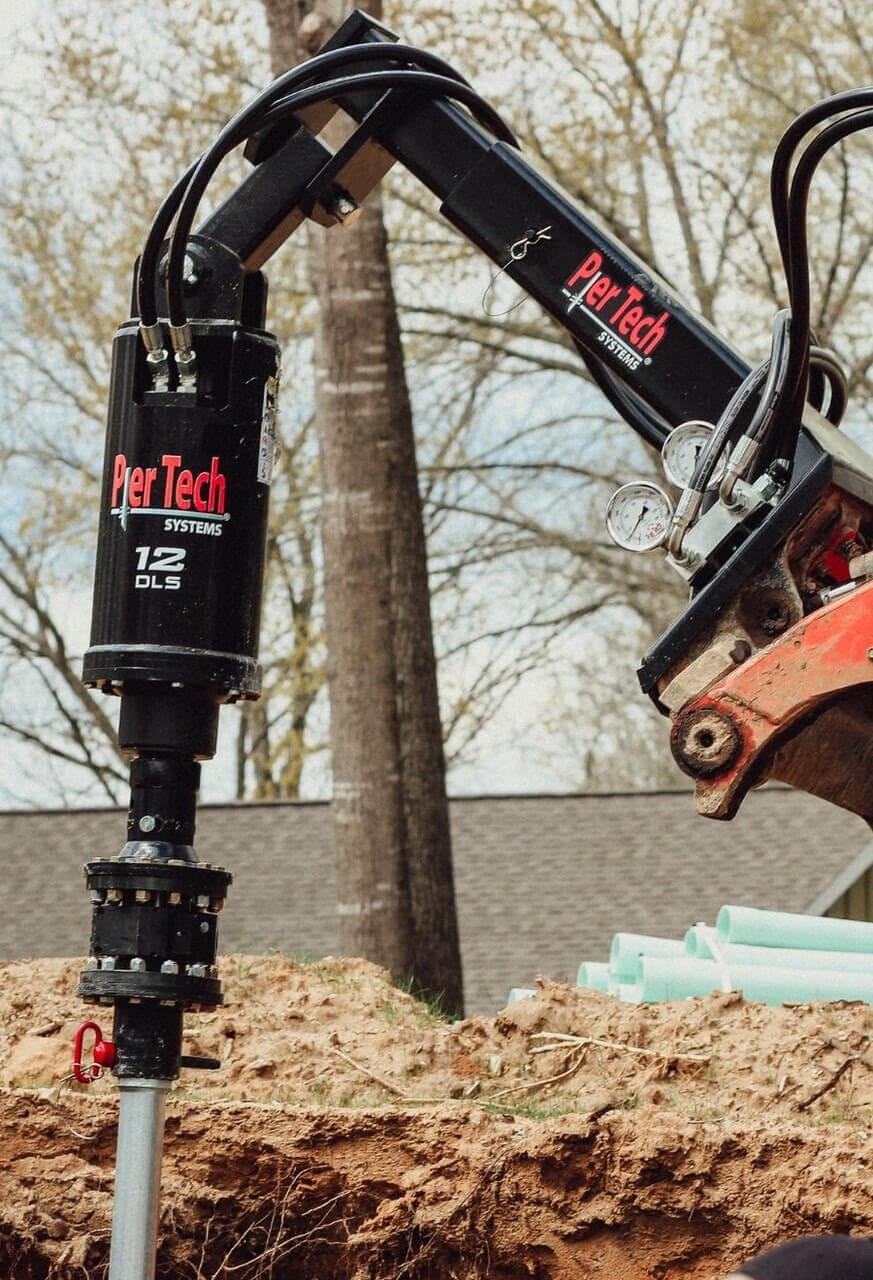
- Drive industrial steel helical piers past the active frost and expansion zone until reaching load-bearing bedrock or dense gravel.
- Mount heavy-duty steel foundation brackets to the footing and hydraulically lift the structure to its true elevation.
- Install continuous subterranean French drains, vapor barriers, and downspout discharge conduits to direct water away from footings.
- Backfill excavated perimeter zones with engineered, non-expansive gravel and apply waterproof membrane sealants.
Executing this sequence ensures complete isolation of foundation footings from unstable surface soils. Deep helical piers anchored into stable strata completely bypass upper soil layers subject to freeze-thaw or swell cycles. Comprehensive site drainage prevents liquid water from collecting where freezing forces could re-occur.
Bay Area Field Case Study: Resolving Severe Heave and Structural Settlement
In an East Bay hillside project, we resolved severe differential heave caused by trapped subterranean moisture and seasonal freeze-thaw cycles that cracked a concrete stem wall by two inches. Our engineering team stabilized the residence by embedding nine deep galvanized helical piers into competent strata and installing a perimeter discharge system to permanently equalize hydrologic pressure.
The Berkeley residential structure suffered from severe interior floor slope and sticking access doors after consecutive wet winters. Uncontrolled roof runoff combined with heavy clay soil had accumulated around the north footing, causing three inches of localized vertical upheaval during cold temperature snaps. Upon inspecting the crawl space, we identified localized concrete spalling along the stem wall and detached post-and-pier supports. Cosmetic patch repairs applied by previous contractors had failed, allowing structural displacement to worsen each season.
We remediated this complex failure by excavating the northern perimeter and attaching foundation brackets to the damaged footing. Our crew mechanically installed nine helical piers to an average depth of 22 feet, penetrating stable bedrock strata. We carefully relieved hydraulic pressure, leveled the framing, and installed a custom perimeter drainage system connected to a dedicated sump pump discharge.
Foundation Repair vs. Seismic Retrofitting Trade-Off Analysis
Selecting between foundation heave repair and seismic retrofitting depends on whether your home suffers from structural foundation displacement or unanchored framing. While heave mitigation installs deep piers and drainage to eliminate vertical uplift, seismic retrofitting anchors wood framing to intact concrete to withstand horizontal shaking. Combining both solutions yields comprehensive protection against ground movement and seismic events.
If your home exhibits structural cracking, sloping floors, or active upheaval, you must prioritize foundation repair and underpinning before attempting seismic reinforcement. Retrofitting an unstable or fractured concrete footing provides zero safety benefits because anchor bolts cannot maintain load-bearing integrity in compromised concrete. Property owners with intact foundations located in high-risk liquefaction regions identified by the U.S. Geological Survey (USGS) Liquefaction Mapping Program should prioritize mudsill bolting and cripple wall bracing. Furthermore, qualifying owners of pre-1980 wood-framed homes can utilize the Earthquake Brace + Bolt (EBB) Program to receive up to 3,000 US dollars in grant funding toward seismic retrofits.
| Engineering Solution | Primary Structural Objective | Typical Cost Range | Load Capacity & Performance | Ideal Soil & Site Conditions |
| Foundation Underpinning | Lifts and stabilizes foundations suffering from heave or settlement. | 12,000 to 35,000 US dollars | High capacity load transfer to bedrock strata. | Deep clay, frost heave, or severe settlement zones. |
| Soil Stabilization & Drainage | Regulates moisture levels and stops heave or expansion cycles. | 4,000 to 12,000 US dollars | Stabilizes soil matrix volume surrounding footings. | Expansive clay and surface water pooling areas. |
| Seismic Retrofitting | Anchors framing to concrete to resist lateral earthquake shaking. | 3,000 to 8,000 US dollars | High shear resistance against lateral movement. | Structurally sound concrete footings on unbolted framing. |
| Crawl Space Encapsulation | Controls subsurface humidity and prevents timber rot or mold. | 5,000 to 14,000 US dollars | Maintains stable environmental conditions under subfloors. | Raised foundations with chronic moisture or standing water. |
Frequently Asked Questions
How do you identify whether your foundation is suffering from frost heave or soil settlement?
You can distinguish foundation heave from settlement by tracking seasonal wall cracking and floor slope direction relative to high-moisture exterior zones. Heave causes upward vertical bulging and inward wall bowing during cold, wet months, whereas settlement leads to downward sagging toward desiccated ground. Inspecting perimeter footings with electronic water levels reveals whether structural points are rising or sinking.
Heave typically concentrates near areas with poor surface drainage or uninsulated exterior footings. Professional laser level surveys provide accurate spatial elevation mapping to confirm structural movement directions.
Can foundation heave resolve itself without engineering intervention?
Foundation heave will not resolve itself without professional engineering intervention because expanded soils and shifted concrete footings do not spontaneously return to their original elevations. Even as saturated soils dry out, erratic soil shrinkage creates uneven voids that worsen settlement cracks and structural stress. Installing deep piers and subsurface drainage provides the only permanent mechanical correction.
Delaying repairs allows water penetration to further degrade concrete integrity and wood framing. Structural movement accelerates over time, leading to higher eventual repair costs.
What is the average cost range for permanent foundation heave repair?
The average cost for permanent foundation heave repair typically ranges from 5,000 US dollars for localized drainage and minor piering to 25,000 US dollars or more for extensive underpinning with deep steel helical piers. Factors influencing final pricing include excavation access, required pier depth, structural engineering permit fees, and concrete stem wall reconstruction requirements.
Investing in engineered repairs preserves overall home equity and protects against catastrophic structural failure. Simple surface drainage enhancements cost significantly less than major underpinning projects.
Does seismic retrofitting fix existing foundation cracks caused by soil heave?
Seismic retrofitting does not fix existing foundation cracks caused by soil heave because its primary objective is anchoring framing to concrete rather than structural lifting. While retrofitting reinforces cripple walls and mudsills against earthquake shaking, fractured concrete footings require dedicated epoxy injection, carbon fiber stitching, or underpinning before retrofitting components can be securely fastened.
We evaluate foundation soundness prior to installing seismic anchors to ensure full code compliance. Combining repairs during retrofitting minimizes labor mobilization overhead.
How long does a deep pier foundation underpinning system last?
A professionally installed deep pier foundation underpinning system is engineered to last over 75 years, often outlasting the building structure itself. Industrial-grade galvanized steel piers resist corrosion and anchor foundation loads deep into stable bedrock far beneath shifting surface soils. Choosing engineered piering eliminates recurring seasonal foundation movement and protects long-term property values.
Transferring structural weight below active soil layers permanently isolates footings from moisture fluctuations. Warranties backed by licensed structural contractors ensure lasting home stability.
Sources
- California Geological Survey: https://www.conservation.ca.gov/cgs
- U.S. Geological Survey Liquefaction Mapping Program: https://www.usgs.gov/programs/earthquake-hazards/science/san-francisco-bay-area-liquefaction-hazard-maps
- California Earthquake Brace + Bolt Program: https://www.earthquakebracebolt.com
Related Articles
Frost Heave In Pavement
Is Frost Heave Covered By Insurance?
Repairing Frost- Damaged Foundations In Colder Microclimates
How To Prevent Frost Heave In Concrete Slabs
Effective Solutions For Repairing Frost Heave Damage In Cold-Weather Regions
People Also Ask
Yes, frost heave damage can be repaired, though the process requires addressing both the visible structural issues and the underlying soil conditions. Frost heave occurs when water in the soil freezes and expands, lifting foundations, slabs, or retaining walls. Repair typically involves removing the affected soil, improving drainage, and replacing it with non-frost-susceptible material like gravel. For existing foundations, underpinning or helical piers may be used to stabilize and relevel the structure. For a comprehensive overview of repair methods and prevention strategies, we recommend reading our internal article titled Effective Solutions for Repairing Frost Heave Damage in Cold-Weather Regions. Golden Bay Foundation Builders emphasizes that proper site evaluation and drainage correction are critical to ensuring a lasting repair in cold-weather regions.
Frost heaves do not simply "go away" on their own; they are a symptom of a deeper issue that requires professional intervention. When the ground freezes, water in the soil turns to ice, expanding and pushing the foundation upward. Once the ground thaws, the soil settles, but the foundation often does not return to its original position, leaving cracks and structural instability. To properly address this, you need to assess and repair the underlying drainage and soil conditions. For comprehensive guidance on this process, please refer to our internal article Effective Solutions for Repairing Frost Heave Damage in Cold-Weather Regions. At Golden Bay Foundation Builders, we recommend a thorough inspection to determine the best course of action for your property.
Repairing frost heave damage requires a systematic approach to address the underlying soil instability. First, you must remove the affected structure or slab, then excavate the frost-susceptible soil to a depth below the frost line. Replace it with a non-frost-susceptible material, such as clean gravel or crushed stone, which drains well and resists ice lens formation. Proper drainage is critical to prevent water from accumulating and refreezing. After compacting the new base, you can rebuild the foundation or slab with reinforcement. For detailed guidance on this process, please refer to our internal article titled Effective Solutions for Repairing Frost Heave Damage in Cold-Weather Regions, which covers best practices for cold-climate repairs. Golden Bay Foundation Builders recommends consulting a structural engineer to assess the specific conditions of your property in Walnut Creek and Contra Costa County.
Generally, standard homeowner insurance policies do not cover frost heave damage. This is because frost heave is typically classified as a result of gradual ground movement, soil settling, or earth movement, which are standard exclusions in most policies. The damage manifests as cracks in foundations, uneven floors, and structural shifting, all of which are considered preventable maintenance issues rather than sudden, accidental events. For property owners in Walnut Creek and Contra Costa County, it is crucial to review your specific policy details. While coverage is rare, some high-value or specialized policies may offer limited endorsements. For expert guidance on assessing and repairing this type of structural issue, our internal article titled 'Effective Solutions for Repairing Frost Heave Damage in Cold-Weather Regions' provides comprehensive strategies. You can find it at Effective Solutions for Repairing Frost Heave Damage in Cold-Weather Regions. Golden Bay Foundation Builders recommends consulting with your insurance agent directly to confirm your coverage limits.
Frost heave occurs when water in the soil freezes and expands, creating ice lenses that push the ground upward. This process can cause significant damage to pavement, leading to cracks, uneven surfaces, and structural failure. The primary factors are freezing temperatures, water availability, and frost-susceptible soil. To prevent this, proper drainage and the use of non-frost-susceptible base materials are essential. For a deeper understanding of how this affects pavement and mitigation strategies, refer to our internal article Frost Heave In Pavement. At Golden Bay Foundation Builders, we always assess soil conditions and drainage to ensure long-lasting pavement performance in Walnut Creek and Contra Costa County.
Frost heave occurs when moisture in the soil freezes, expanding and lifting concrete slabs. This can cause cracking and uneven surfaces. To prevent this, proper site preparation is critical. This includes excavating to a depth below the frost line, typically 12 to 18 inches in Walnut Creek and Contra Costa County, and using a well-draining gravel base. Insulating the slab edges can also help. For comprehensive guidance, please refer to our internal article How To Prevent Frost Heave In Concrete Slabs. Golden Bay Foundation Builders always recommends consulting a structural engineer for site-specific soil analysis to ensure long-term stability.
Frost heave occurs when water in the soil freezes, expands, and pushes the ground upward. Common signs include visible lifting or tilting of concrete slabs, such as your foundation, driveway, or sidewalk. You may notice cracks in walls, sticking doors or windows, and uneven floors inside your home. Outside, look for soil that appears mounded or cracked near the foundation. These indicators suggest the ground beneath your structure is shifting due to freezing conditions. For professional guidance on addressing this issue, Golden Bay Foundation Builders recommends reviewing our internal article titled Effective Solutions for Repairing Frost Heave Damage in Cold-Weather Regions, which covers effective repair strategies for cold-weather regions.