

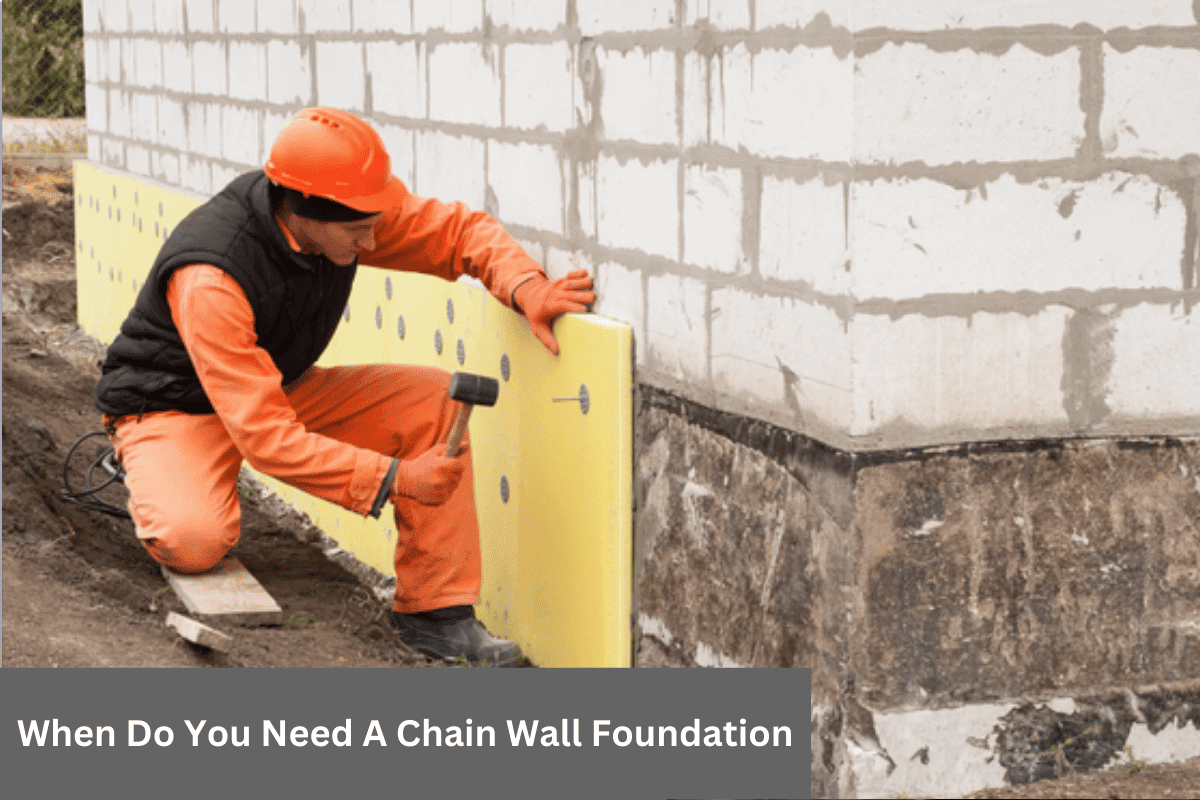
So, you’re staring at your property plans, scratching your head, and wondering, “Do I really need a chain wall foundation?” Maybe your contractor mentioned it, or you’ve got a sneaking suspicion your sloping backyard is plotting against you. Either way, you’ve come to the right place. At Golden Bay Foundation Builders, we’ve seen it all—from “minor” soil shifts that turned into backyard landslides (oops) to DIYers who thought YouTube tutorials could outsmart gravity. Let’s cut through the confusion and talk about when a chain wall foundation isn’t just a good idea—it’s a non-negotiable.
What Even Is a Chain Wall Foundation? (Spoiler: It’s Not a Necklace for Your House)
Before we dive into the “when,” let’s tackle the “what.” A chain wall foundation is basically a reinforced concrete wall that runs continuously around the perimeter of a structure. Think of it as the backbone of your building, especially if you’re dealing with tricky terrain or heavy loads. Unlike isolated footings (which are like placing your house on a bunch of stilts), a chain wall spreads the weight evenly and locks everything into place.
Here’s why we’re obsessed with them at Golden Bay:
- They’re tough cookies: Perfect for resisting lateral soil pressure (translation: when your yard tries to shove your house downhill).
- They play nice with slopes: Building on a hill? A chain wall laughs in the face of gravity.
- They’re versatile: Use ’em for basements, crawl spaces, or to anchor retaining walls.
When Your Property Screams “Chain Wall or Bust”
Not every project needs a chain wall, but when they do, the signs are blinking neon. Let’s walk through the biggies.
1. Your Land Has More Slopes Than a Ski Resort
If your lot looks like it’s auditioning for a mountain biking video, a chain wall foundation is your best friend. Sloped sites need serious stabilization to prevent soil creep (yes, that’s a real term—and no, it’s not as cute as it sounds). We’ve rescued more than a few Homeowners who tried to cheap out with a basic footing, only to find their garage slowly moonwalking down the hill.
Pro Tip: Check out our guide to building on sloped land for more “hold my coffee” moments.
2. You’re Building Heavy (We’re Talking Castles, Not Cardboard)
Planning a two-story Home? Adding a stone fireplace that weighs as much as a pickup truck? Chain walls handle heavy loads like a champ. Isolated footings might save you a few bucks upfront, but uneven settling could leave your floors slanted enough to rival a funhouse.
3. Expansive Soils Are Lurking Beneath You
Clay-heavy soils swell when wet and shrink when dry, which is about as stable as a Jenga tower in an earthquake. If your soil report reads like a horror novel, a chain wall’s continuous support can keep your foundation from cracking under pressure—literally.
4. You Want a Basement (Without the Swimming Pool Vibes)
Basements need walls that can resist water pressure and soil pushback. Chain walls are the go-to here, especially when paired with waterproofing. Trust us: nobody wants a basement that doubles as a soggy cave.
“But How Do I Know I Need One?” (Spoiler: Ask Us, But Here’s a Cheat Sheet)
Still unsure? Let’s simplify with a table that even your DIY-obsessed cousin could understand:
| Scenario | Chain Wall? | Why? |
|---|---|---|
| Steep slope (>15% grade) | ✅ Yes | Prevents soil movement and structural tilt. |
| Heavy structure (2+ stories) | ✅ Yes | Distributes weight evenly; reduces settling. |
| Expansive clay soil | ✅ Yes | Resists soil expansion cycles. |
| Flat lot with sandy soil | ❌ No | Basic footings or slabs usually suffice. |
Why Golden Bay’s Chain Walls Don’t Just “Work”—They Outwork
Look, we get it. Foundation talk isn’t exactly cocktail party material. But here’s where we flex a little: Golden Bay Foundation Builders doesn’t just slap concrete into a trench and call it a day. We’ve spent years refining our process to avoid the classics—like the time a client’s “budget” chain wall cracked because someone skimped on rebar. Here’s our no-BS approach:
- Custom engineering: We test soil, analyze load needs, and design walls that won’t bail on you.
- Quality materials: High-strength concrete, corrosion-resistant rebar—no corner-cutting.
- Drainage smarts: Because even the best wall can’t fight a swamp.
FYI, we’ve got a whole post on why materials matter. (Spoiler: wet concrete isn’t just “cement soup.”)
3 Chain Wall Myths—Busted
Let’s squash some rumors before your uncle’s contractor friend chimes in:
- “Chain walls are overkill for small homes.”
Tell that to the tiny house that slid into a ravine. Size ≠ stability. - “You can skip permits if it’s just a shed.”
Unless you want your shed to become the HOA’s nemesis, get the permits. - “DIY chain walls save money!”
Sure, if you enjoy crying over cracked concrete. Leave it to pros (hi, that’s us).
FAQs: Because Googling “Foundation Panic” Isn’t a Solution
Can I add a chain wall later if my foundation fails?
Technically? Yes. Practically? It’s like doing heart surgery on a marathon runner mid-race. Prevention beats repair every time.
How much does a chain wall cost compared to footings?
Roughly 20–30% more upfront. But considering the cost of fixing a failed foundation? Worth. Every. Penny.
Will a chain wall guarantee no cracks?
Nothing’s bulletproof, but it’s the closest thing. Proper drainage and soil prep are key—which is why we handle all of it 🙂
Wrapping Up: Don’t Let Your Foundation Be an Afterthought
Chain walls aren’t glamorous, but neither is a sinking porch. If your project ticks any of the boxes we’ve covered—slopes, heavy loads, moody soils—it’s time to call in the cavalry. At Golden Bay Foundation Builders, we’ve turned foundation nightmares into success stories for over a decade. Why? Because we’d rather geek out over soil reports than explain to someone why their living room now has a water feature.
Ready to build smart, not sorry? Let’s chat. Your house (and sanity) will thank you.
.
People Also Ask
In general, a 2-foot retaining wall does require a footing, though specific local codes in Walnut Creek CA and Contra Costa County will dictate the exact requirements. A proper footing, typically a concrete base that extends below the frost line, is essential for distributing the wall's weight and resisting lateral earth pressure. Without it, the wall is prone to shifting, cracking, or even collapsing over time. For a 2-foot wall, a common standard is a footing that is at least 6 to 8 inches thick and twice the width of the wall block. For professional guidance on your project, Golden Bay Foundation Builders recommends consulting with a local engineer to ensure compliance with all regional building codes.
For a typical home in Walnut Creek or Contra Costa County, a stem wall foundation generally costs between $8 and $15 per square foot. This price includes the concrete footing, the concrete block or poured wall, and the necessary rebar reinforcement. The final cost depends heavily on the height of the stem wall, soil conditions, and the complexity of the site. For a standard 2,000 square foot home, this type of foundation is a very common choice. For a detailed breakdown of pricing for a project of that size, you can refer to our internal article How Much Does A 2000 Square Foot Foundation Cost?. Golden Bay Foundation Builders always recommends getting a site-specific evaluation, as local soil reports can significantly impact the final estimate.
While buying a house built on a slab foundation can be a cost-effective option, there are important drawbacks to consider. Slab foundations offer limited access for repairs, as plumbing and electrical lines are embedded directly in the concrete. If a pipe leaks, you may face expensive and invasive repairs that require jackhammering into the floor. Additionally, slabs can be prone to cracking in areas with expansive clay soils, which is common in parts of Contra Costa County. This can lead to uneven floors and structural issues over time. For homeowners seeking greater flexibility and easier maintenance, a raised foundation with a crawl space is often a better choice. For a detailed comparison of these options, please review our internal article Mat Foundation vs. Slab-on-Grade: Which Foundation is Right for Your Project?. At Golden Bay Foundation Builders, we always recommend a thorough site evaluation before making a decision.
The 1/3 rule is a key guideline for retaining wall drainage. It states that the height of the drainage aggregate (like gravel) placed behind the wall should be at least one-third of the total wall height. For example, a 6-foot wall requires at least 2 feet of gravel backfill. This ensures proper water pressure relief, preventing hydrostatic buildup that can cause wall failure. At Golden Bay Foundation Builders, we always follow this industry standard to protect structural integrity. Proper drainage, including a perforated pipe at the base, is essential for long-term stability in Walnut Creek and Contra Costa County.