

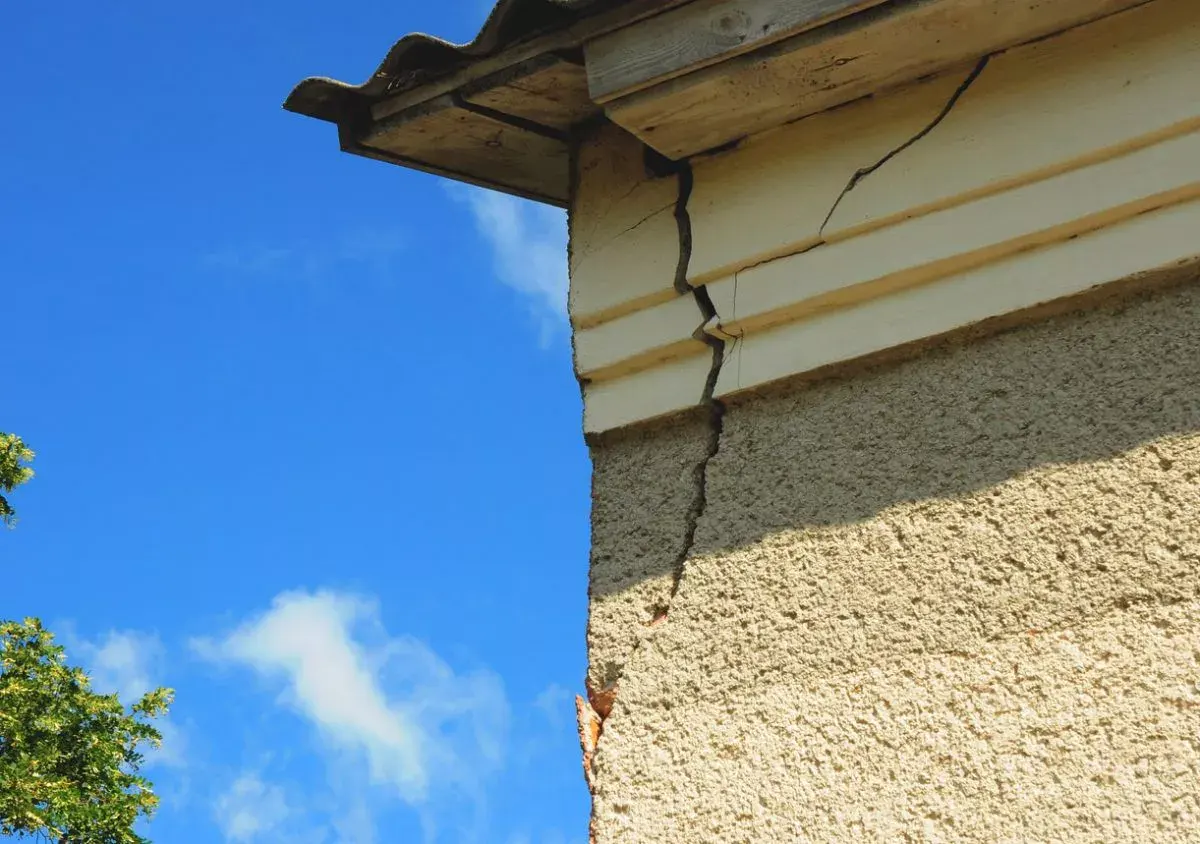
Fundamental Physics: Structural Integrity vs. Surface Degradation
Structural cracks stem from load-bearing component displacement driven by soil movement or foundation settlement, while plaster cracks represent superficial surface curing or thermal expansion within non-load-bearing wall finishes. Distinguishing between these mechanisms prevents property owners from ignoring severe load-bearing hazards or wasting capital on unnecessary structural repairs.
Structural framing members—such as reinforced concrete footings, stem walls, grade beams, steel beams, and load-bearing studs—transfer gravity, lateral earth pressure, and seismic forces into supporting subsoils. When stress exceeds component capacity or subsoil bearing support fails, structural members deform and fracture. This underlying structural movement directly telegraphs upward into interior wall finishes.
Plaster and drywall finishes serve exclusively as non-load-bearing architectural cladding. Traditional three-coat plaster applications and modern drywall assemblies are rigid and brittle. As hydration water leaves plaster binders during curing, microscopic shrinkage stress develops across the finish. Furthermore, temperature shifts and room humidity variations cause wood lath and framing timber to expand and contract continuously.
Contextual Engineering Metrics
Engineers evaluate structural cracking risk by analyzing width thresholds, differential settlement ratios, and shear displacement across building surfaces. Hairline fractures below 1.5 millimeters typically signal non-structural material shrinkage, whereas cracks exceeding 3 millimeters or exhibiting vertical plane offsets indicate structural foundation movement requiring remediation.
- Plaster Shrinkage Threshold: Hairline cracks under 1.5 millimeters (1/16 inch) in width are almost always non-structural, resulting from material curing, drying shrinkage, or indoor ambient temperature shifts.
- Structural Action Boundary: Fractures measuring wider than 3 millimeters (1/8 inch), or exhibiting shearing offset between opposite sides of the break, indicate structural foundation displacement.
- Load Vector Indicators: Diagonal cracks oriented at 45-degree angles above door headers or window openings signal shear stress induced by localized differential settlement.
- Soil Hydration Pressures: Expansive soils exert lateral swelling pressures exceeding 10,000 pounds per square foot against concrete stem walls, generating severe horizontal foundation cracking.
- Structural Standard Guidelines: Performance standards published by the American Society of Civil Engineers (ASCE) establish that differential foundation settlement exceeding 1/240th of the span length typically induces visible structural framing distortion.
Diagnostic Comparison: Structural vs. Plaster Cracks
Distinguishing structural wall fractures from cosmetic plaster defects requires evaluating primary root causes, crack orientation, dimensional width, plane displacement, and seasonal movement patterns. The engineering framework below compares these technical parameters to assist Bay Area property owners and field inspectors in diagnosing wall distress accurately.
| Diagnostic Parameter | Structural Crack | Cosmetic Plaster / Drywall Crack |
|---|---|---|
| Primary Root Cause | Differential foundation settlement, expansive soil heave, seismic shear | Material curing shrinkage, thermal expansion, framing timber drying, aged skim coat |
| Typical Width | Exceeds 3 millimeters (1/8 inch); often wider than 6 millimeters (1/4 inch) | Less than 1.5 millimeters (1/16 inch); fine hairline presentation |
| Directional Orientation | Diagonal (45 degrees), stair-step along mortar joints, or continuous horizontal | Straight vertical along panel seams, horizontal ceiling joints, or micro-crazing |
| Plane Displacement | Significant shearing offset; one edge projects outward beyond the opposing edge | Completely flat and flush across both fracture edges |
| Wall Location | Primary load-bearing exterior walls, foundation stem walls, door/window corners | Non-load-bearing partition walls, taped drywall seams, decorative ceiling corners |
| Seasonal Behavior | Widens progressively or opens and closes with wet/dry soil cycles | Static over time or fluctuates slightly with seasonal indoor relative humidity |
| Associated Structural Signs | Sticking doors, sloping subfloors, cracked exterior brick, foundation wall breaks | Unaffected door frames, level subfloors, intact exterior foundation walls |
| Water Intrusion Risk | High; provides direct pathways for groundwater or vapor migration | Negligible; restricted to interior decorative finish layers |
| Remediation Approach | Foundation underpinning, helical piers, carbon fiber reinforcement | V-groove excavation, fiberglass mesh bridging, joint compound refinishing |
Physical Indicators: Reading Crack Morphology
Analyzing crack morphology provides crucial diagnostic insight into the magnitude, direction, and structural source of mechanical stress acting upon a property. By evaluating orientation, dimensional width, and surface plane offset, field inspectors can isolate active foundation settlement from harmless plaster curing fractures.
Crack Orientation and Geometric Patterns
The physical direction of a wall crack traces the primary vector of stress moving through the building envelope. Diagonal shear lines, stair-step masonry fractures, and continuous horizontal basement breaks indicate serious foundation displacement, while straight vertical tape seams and network crazing reflect superficial surface finish separation.
- Diagonal Cracks (45-Degree Shear Lines): Fractures extending diagonally from the top corners of window or door frames indicate differential settlement, where one section of the foundation drops relative to adjacent footings.
- Stair-Step Cracks: Fractures following mortar joints in brick veneer, stone, or concrete block walls signal localized foundation settlement or lateral soil movement along exterior footings.
- Horizontal Cracks: Continuous horizontal lines running parallel to basement floors or along stem walls signal inward foundation bowing caused by excessive hydrostatic pressure or expansive soil swelling.
- Straight Vertical or Horizontal Seam Cracks: Perfectly straight fractures running along drywall panel edges indicate failed seam taping, insufficient joint compound application, or minor framing lumber drying.
- Crazing and Spiderweb Patterns: Interconnected web-like hairline fractures across plaster surfaces stem from rapid surface drying during initial installation or age-related brittleness of topcoat coats.
Dimensional Width and Plane Offset
Measuring crack width establishes preliminary severity, but assessing three-dimensional plane offset provides conclusive proof of structural shear displacement. When one side of a fracture projects outward past the opposing face, underlying structural framing has shifted, whereas cosmetic plaster cracks remain perfectly flat across the break edge.
In our diagnostic practice, we align physical evaluations with geological and soil hazard criteria maintained by the U.S. Geological Survey (USGS) to account for regional ground response. Running a gloved finger perpendicular across a crack edge reveals whether shearing displacement is present. If the finger catches a sharp structural lip, shear movement has occurred, whereas pure surface plaster fractures maintain smooth continuity.
Geological and Seismic Soil Factors in the Bay Area
San Francisco Bay Area geotechnical conditions, characterized by highly expansive clay soils, shallow Bay Mud deposits, and active fault activity, create significant recurring foundation stresses. Seasonal shifts between wet winters and dry summers cause expansive clay subsoils to swell and contract, driving cyclical structural settlement.
During wet winter months, expansive clays absorb heavy rain, swelling in volume and exerting upward heave against concrete footings and slab floors. In hot, dry summer months, these clay soils lose moisture, desiccate, and shrink away from foundation perimeters, depriving footings of uniform bearing support.
This cyclical volume change causes perimeter foundation footings to drop in late summer and rise in late winter. Interior structural cracks frequently open during dry months and pull tight following winter rains. Property owners often mistake this seasonal opening and closing for minor cosmetic expansion, when it actually signals active foundation movement driven by expansive soil dynamics.
Real-World Bay Area Case Studies: Engineering Analysis and Resolution
Field investigations throughout Northern California demonstrate how misdiagnosing wall fractures leads to repeated cosmetic repair failures or unnecessary underpinning expenditures. The following real-world field cases illustrate our systematic diagnostic engineering procedures and successful permanent resolutions for complex structural and non-structural wall distress.
Case 1: Active Differential Settlement in San Jose Clay Soils
In a San Jose residential project, recurring diagonal interior wall cracks above door frames re-emerged despite five consecutive plaster patching attempts. Our comprehensive engineering elevation survey confirmed active differential foundation settlement driven by severe seasonal drying and wetting cycles within underlying expansive clay soils.
Our digital floor elevation survey mapped a 2.1-inch drop toward the southeast perimeter footing over a 20-foot distance. Uncontrolled roof downspout drainage saturated clay soils along the eastern perimeter while the south elevation remained dry and desiccated, creating severe differential soil strain beneath the house.
- We installed eight steel push piers beneath the settled southeast perimeter foundation down to stable bearing strata at a depth of 18 feet.
- The home was hydraulically lifted back toward its original level elevation, closing the 45-degree interior wall fractures by over 80 percent.
- We regraded the exterior soil perimeter and extended downspouts six feet away from the foundation to stabilize soil hydration levels.
- The interior plaster walls were reinforced with carbon fiber mesh and patched with high-strength setting compound, yielding permanent stability.
Case 2: East Bay Hills Ceiling Separation Misidentified as Structural Failure
In an Oakland Hills residence, property owners observed a severe 3/8-inch horizontal gap opening across an upstairs ceiling-to-wall junction during mid-winter, fearing foundation failure. Our elevation survey confirmed the foundation remained perfectly level, isolating the fracture to non-structural roof truss uplift driven by attic thermal gradients.
Our digital level measurements confirmed that subfloors and stem walls were level within acceptable residential performance thresholds across the entire building footprint. Inspection of the unconditioned roof attic space revealed engineered wood roof trusses bowing upward during winter because cold, damp attic air expanded top chords while bottom chords buried under deep insulation remained dry and warm.
- We re-secured ceiling drywall panels using slotted L-brackets that allow the roof truss bottom chords to move vertically without pulling wall plaster.
- Interior drywall fasteners within 16 inches of partition wall intersections were removed to isolate plaster surfaces from vertical truss displacement.
- We finished the ceiling-to-wall joint with flexible acrylic sealant and decorative crown molding attached exclusively to the ceiling joists.
Field Diagnostic Methods and Monitoring Protocols
Accurately diagnosing wall cracks requires systematic physical measurement and continuous monitoring using calibrated engineering tools prior to executing repairs. Installing precision monitoring equipment over dedicated timeframes determines whether wall movement is active, seasonal, or historic and static.
+-----------------------------------------------------------------------+
|                       WALL CRACK DIAGNOSTIC FLOW                      |
+-----------------------------------------------------------------------+
                                   |
                                   v
                      Measure Crack Width & Plane
                                   |
         +-------------------------+-------------------------+
         |                                                   |
         v                                                   v
 Width < 1.5 mm (1/16 in)                           Width > 3.0 mm (1/8 in)
 Plane Offset: Flat                                  Plane Offset: Ridged / Offset
 Direction: Vertical / Seam                          Direction: Diagonal / Stair-Step
         |                                                   |
         v                                                   v
+------------------+                                +-------------------+
|  Cosmetic Issue  |                                |  Structural Issue |
+------------------+                                +-------------------+
         |                                                   |
         v                                                   v
Patch with joint compound                           Install Tell-Tale Monitor
Monitor humidity changes                            Schedule Structural Evaluation
Ascertaining crack movement vectors prevents premature cosmetic repairs that would otherwise fail under ongoing soil movement. We utilize precision engineering tools to record crack width, vertical shearing, and structural frame movement over multi-month diagnostic windows.
- Tell-Tale Crack Monitors: Two-piece acrylic grid monitors mounted across fractures with epoxy adhesive, recording horizontal and vertical displacement down to 0.5 millimeter precision.
- Calibrated Optical Crack Gauges: Handheld transparent measuring cards used to log baseline fracture widths over monthly inspection cycles.
- Electronic Digital Levels: Digital manometer systems capable of mapping floor elevation contours across 0.1-inch tolerances to correlate wall cracks with slab deflection.
- Subsurface Moisture Sensors: Non-destructive moisture meters utilized to detect localized plumbing leaks or subterranean water accumulation behind plaster lath.
Remediation Strategies: Cosmetic Restoration vs. Structural Stabilization
Determining whether to perform surface cosmetic repairs or structural foundation stabilization depends strictly on whether the underlying building frame is undergoing active movement. Executing cosmetic repairs over active structural fractures leads to guaranteed failure, whereas underpinning static cosmetic defects wastes substantial financial resources.
Cosmetic Plaster and Drywall Restoration
Repairing non-structural plaster cracks requires mechanical channel excavation, joint reinforcement, and high-strength setting compounds capable of accommodating minor material movement. Proper cosmetic restoration protocols prevent edge telegraphing, surface flashing, and premature joint cracking on non-load-bearing wall finishes.
- V-Groove Excavation: Widening the hairline fracture into a V-shaped channel using a joint knife to remove loose plaster particles and establish a mechanical bond key.
- Substrate Bridging: Applying self-adhesive fiberglass mesh tape over the excavated channel to distribute localized strain across a wider surface area.
- Setting Compound Application: Applying two to three coats of chemical-setting joint compound rather than air-drying mud to minimize curing shrinkage and maximize bond strength.
Structural Foundation Stabilization Strategies
Resolving structural wall cracks requires stabilizing the underlying building foundation through deep pier underpinning, lateral wall anchoring, or subsoil density enhancement. Restoring structural support arrests ongoing movement, ensuring interior cosmetic wall repairs remain permanently stable without recurring shear failure.
- Steel Pier Underpinning: Hydraulically driving heavy-duty steel pier shafts through weak surface soils into competent load-bearing strata to stabilize or lift settled foundations.
- Carbon Fiber Grid Reinforcement: Bonding high-tensile carbon fiber straps to bowed concrete foundation walls with structural epoxy to resist lateral hydrostatic pressure.
- Polyurethane Subsoil Grouting: Injecting high-density polyurethane foam into soft soil voids to compact bearing strata and restore uniform foundation support.
Estimated Cost Comparison
Project expenses vary dramatically between minor cosmetic plaster repairs and full structural foundation underpinning across the San Francisco Bay Area. Reviewing typical regional cost ranges helps property owners evaluate contractor proposals, establish realistic project budgets, and select appropriate engineering solutions.
| Scope of Work | Estimated Cost Range | Engineering Description |
|---|---|---|
| Cosmetic Plaster Repair | 250 to 900 US dollars | V-groove excavation, fiberglass mesh application, chemical setting compound, sanding, and painting. |
| Forensic Structural Engineering Inspection | 600 to 1,800 US dollars | On-site elevation survey, crack mapping, geotechnical analysis, and stamped engineering report. |
| Carbon Fiber Wall Stabilization | 4,500 to 11,000 US dollars | Structural epoxy installation of carbon fiber grid straps along bowed concrete or masonry walls. |
| Deep Helical / Push Pier Underpinning | 12,000 to 40,000 US dollars | Exterior excavation, installation of 6 to 14 deep steel piers, hydraulic foundation lifting, and backfilling. |
Frequently Asked Questions
Addressing common property owner concerns regarding wall cracks requires clear technical distinction between non-load-bearing finish degradation and active foundation displacement. The following concise answers address key questions about diagnosing, monitoring, and repairing structural and plaster fractures.
Can a cosmetic plaster crack develop into a structural foundation issue over time?
No, a cosmetic plaster crack cannot transform into a structural foundation issue because plaster is a non-load-bearing surface finish. However, an unaddressed foundation settlement issue can worsen over time, causing small initial hairline plaster fractures to expand into major structural shear gaps.
How can Bay Area property owners distinguish between seismic shaking cracks and foundation settlement cracks?
Seismic shaking typically causes sudden, widespread hairline cracking at ceiling corners and wall intersections throughout the entire building immediately following an earthquake. In contrast, foundation settlement cracks develop gradually over months, concentrate around settled footings, and coincide with sloping floors or sticking door frames.
Should structural wall cracks be sealed with epoxy before foundation repairs are completed?
No, structural wall cracks should never be filled with rigid epoxy prior to completing foundation stabilization repairs. Filling active fractures before stabilizing the structure causes subsequent movement to break the epoxy seal or force new, wider cracks in adjacent wall sections.
What crack width threshold indicates that an immediate professional inspection is required?
Any wall crack exceeding 3 millimeters (1/8 inch) in width warrants a professional structural evaluation. Furthermore, any fracture displaying outward plane offset, stair-step patterns in exterior masonry, or horizontal running lines on basement foundation walls requires immediate expert assessment.
Why do structural wall cracks in the Bay Area open during summer and close during winter?
Structural wall cracks fluctuate seasonally because Bay Area expansive clay soils desiccate and shrink during dry summer months and swell with rainwater during winter storms. Summer soil shrinkage causes perimeter footings to drop and open cracks, while winter swelling lifts footings and forces cracks shut.
Sources
- American Society of Civil Engineers (ASCE). Guidelines for the Evaluation and Repair of Residential Foundations. https://www.asce.org
- U.S. Geological Survey (USGS). Earthquake Hazards and Quaternary Fault Maps of the San Francisco Bay Area. https://www.usgs.gov
- U.S. Department of Housing and Urban Development (HUD User). Residential Structural Design Guide. https://www.huduser.gov
People Also Ask
Determining if a plaster crack is structural requires careful observation. A structural crack is typically wider than 1/8 of an inch, runs in a continuous line, and may extend through the plaster into the underlying substrate. You will often see a diagonal pattern moving from a corner of a door or window, or a stair-step pattern in masonry walls. Another key sign is if the crack is accompanied by doors or windows that stick, or if the floor feels uneven. For a thorough assessment, you should always consult a professional. For more specific guidance after a seismic event, please refer to our internal article How To Check Cracks After An Earthquake?, which provides detailed steps on how to evaluate your property.
Plaster is still used, but its popularity has declined in modern construction due to the rise of drywall. Drywall is faster to install, requires less skilled labor, and is more cost-effective for large-scale projects. Plaster, while offering superior durability, soundproofing, and a classic finish, demands significant expertise and time to apply correctly. It also takes longer to dry and can be more expensive. For homeowners in Walnut Creek and Contra Costa County, plaster remains an excellent choice for historic home restorations or custom finishes where longevity and aesthetics are paramount. At Golden Bay Foundation Builders, we often recommend plaster for specific applications, but drywall is the standard for most new builds due to its efficiency.
Structural damage cracks often display distinct characteristics that set them apart from cosmetic surface cracks. You should look for cracks that are wider than 1/8 of an inch, as these can indicate significant movement. Horizontal cracks in foundation walls, especially those that bulge or step in a stair-step pattern along brick or block joints, are serious red flags. Cracks that appear suddenly or grow over time also warrant immediate attention. For a comprehensive breakdown of what to watch for during a property evaluation, our internal article Spotting Structural Red Flags During Home Inspections: A Bay Area Homeowner’s Definitive Guide provides detailed guidance tailored to Bay Area homes. At Golden Bay Foundation Builders, we always recommend a professional inspection if you observe any of these signs, as early detection can prevent costly structural repairs.
For homeowners in Walnut Creek and Contra Costa County, the cost to repair structural cracks varies widely based on severity and cause. Minor, non-structural cracks (like hairline shrinkage) might cost a few hundred dollars for simple epoxy injection. However, structural cracks—those wider than 1/8 inch, with lateral displacement, or accompanied by bowing walls—require professional engineering. These repairs typically range from $800 to $3,000 for carbon fiber straps or helical anchors, with more complex foundation underpinning or wall replacement costing $5,000 to $15,000 or more. A proper diagnosis is critical to avoid wasted money on cosmetic fixes. For a deeper comparison of safety and effectiveness, we recommend reading our internal article titled DIY vs. Professional Foundation Crack Repair: Which is Safer and More Effective?. Golden Bay Foundation Builders always advises getting a structural engineer's assessment before committing to any repair method.


Comments are closed