

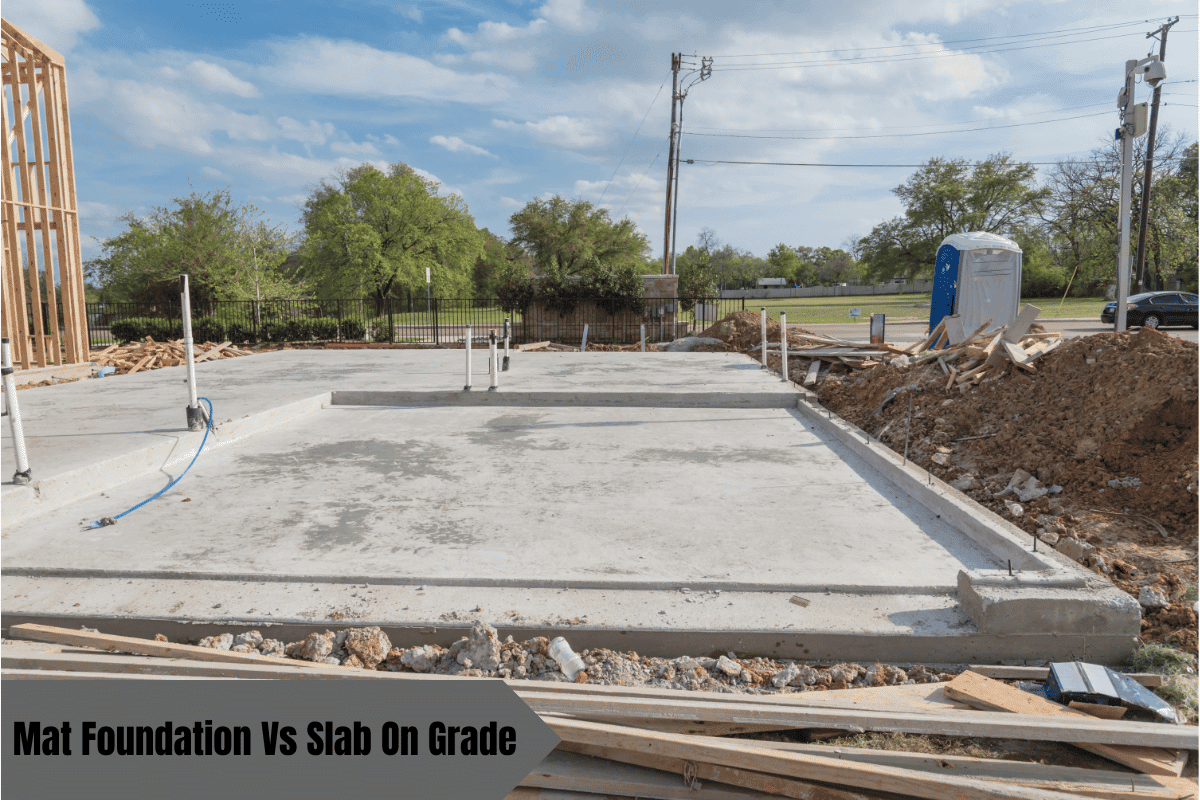
A mat foundation (raft foundation) is a thick, heavily reinforced concrete slab spanning the entire building footprint, engineered to carry the full structural load and distribute it across weak or variable soils. A slab-on-grade foundation is a thinner concrete slab poured directly on prepared ground, acting primarily as a finished floor surface while structural loads are borne by separate perimeter footings. Choose a mat foundation when soil bearing capacity is below 2,000 psf, expansive clay is present, seismic demands are high (Seismic Design Categories D, E, F), or heavy column loads would otherwise require footings covering more than 50 percent of the building footprint. Choose a slab-on-grade foundation on stable, well-drained granular soils with bearing capacity above 3,000 psf, moderate frost depths, and for single-family residential or low-rise structures where initial budget is the primary constraint.
1. Foundation Definitions and Structural Distinctions
1.1 Mat Foundation (Raft Foundation)
-
A continuous, monolithic reinforced concrete slab extending under the entire structure.
-
Transfers combined dead, live, and lateral loads from the superstructure to the soil through a single rigid element.
-
Thickness ranges from 10 to 14 inches for residential, 2 to 8 feet or more for commercial and high-rise buildings.
-
Reinforcement consists of two-way top and bottom steel rebar cages designed for positive and negative bending moments.
-
Reduces bearing pressure to levels acceptable for weak soils (less than 2,000 psf).
-
Commonly used on expansive clay, loose sand, compressible silt, variable fill, and sites with high seismic risk.
1.2 Slab-on-Grade Foundation
-
A concrete slab, typically 4 to 6 inches thick (residential), poured directly on compacted granular subgrade.
-
A vapor barrier (6-mil to 15-mil polyethylene) separates the slab from the ground to prevent moisture intrusion.
-
Structural building loads are carried by thickened perimeter footings or grade beams, not by the floor slab itself.
-
Reinforcement (welded wire mesh or light rebar) primarily controls shrinkage cracking and temperature stress.
-
Best suited for stable, well-draining granular soils with bearing capacity of at least 3,000 psf and low plasticity.
2. Detailed Side-by-Side Technical Comparison
| Criteria | Mat Foundation | Slab-on-Grade Foundation |
|---|---|---|
| Primary function | Structural load-bearing element for entire building | Finished floor; loads borne by separate footings |
| Typical thickness | 10 inches to 8 feet | 4 to 6 inches (residential), 8 to 12 inches (commercial) |
| Reinforcement | Two-way top and bottom rebar cages | Welded wire mesh or light rebar (crack control) |
| Minimum soil bearing capacity | Functions on soils below 2,000 psf | Requires 3,000 psf or higher for reliable performance |
| Cost range (2026 Bay Area) | 22 to 43 dollars per sq ft | 8 to 16 dollars per sq ft |
| Excavation depth | 2 to 4 feet below grade (deeper for basements) | 6 to 12 inches below finished floor |
| Construction timeline (residential) | 3 to 6 weeks | 1 to 2 weeks |
| Seismic performance | Excellent – integral diaphragm resists lateral forces | Fair – requires supplemental shear walls and hold-downs |
| Frost resistance | Extends below frost line or uses engineered insulation | Requires Frost-Protected Shallow Foundation (FPSF) in cold climates |
| Utility access | Extremely difficult – pipes embedded in structural concrete | Difficult – slab demolition required for under-slab repairs |
| Expected lifespan | 75 to 100+ years | 50 to 75 years |
| Best soil types | Expansive clay, loose sand, compressible silt, fill | Stable, well-compacted granular soils with low plasticity |
3. Soil Conditions: The Decisive Factor
3.1 Soil Bearing Capacity Thresholds
-
Soil bearing capacity below 2,000 psf → Mat foundation strongly recommended. The large footprint reduces contact pressure to safe levels.
-
Bearing capacity between 2,000 and 3,000 psf → Either type may work; selection depends on structural loads, climate, and seismic demands.
-
Bearing capacity above 3,000 psf → Slab-on-grade with conventional footings is usually the most economical choice, provided soil is not expansive.
3.2 Expansive Soils and the Mat Foundation Advantage
Expansive clay soils, prevalent throughout the Bay Area, swell when wet and shrink when dry, generating uplift pressures that distort slab-on-grade foundations. A mat foundation resists this movement through:
-
Mass and rigidity that counteract swelling uplift.
-
Continuous two-way reinforcement that distributes stress and prevents localized cracking.
-
Uniform settlement ensured by monolithic design, minimizing differential movement.
For highly expansive soils, combining a mat foundation with soil stabilization (chemical treatment to reduce clay water absorption) provides maximum protection.
3.3 When Slab-on-Grade Is the Right Soil Match
-
Granular, well-drained soils with plasticity index (PI) less than 15.
-
Consistent soil strata across the building footprint.
-
Groundwater table at least 4 feet below finished floor elevation.
-
No fill, debris, or organic material within the bearing zone.
-
Soil bearing capacity of 3,000 psf or greater.
4. Cost Comparison: Construction and Lifecycle Economics
4.1 Initial Construction Costs (2026 Bay Area Estimates)
| Cost Category | Mat Foundation (per sq ft) | Slab-on-Grade (per sq ft) |
|---|---|---|
| Site preparation & excavation | 3 to 6 dollars | 1 to 3 dollars |
| Concrete material | 8 to 15 dollars | 3 to 5 dollars |
| Steel reinforcement | 4 to 8 dollars | 1 to 2 dollars |
| Formwork and labor | 5 to 10 dollars | 2 to 4 dollars |
| Engineering and design | 2 to 4 dollars | 1 to 2 dollars |
| Total estimated range | 22 to 43 dollars | 8 to 16 dollars |
| Typical 2,000 sq ft home total | 44,000 to 86,000 dollars | 16,000 to 32,000 dollars |
Costs exclude architectural finishes, insulation, and mechanical rough-ins. Obtain a site-specific estimate from a qualified foundation contractor.
4.2 Lifecycle Cost Considerations
-
Slab-on-grade under-slab plumbing repair: 2,000 to 10,000 dollars due to concrete demolition and restoration.
-
Crack repair (epoxy injection) per incident: 500 to 2,500 dollars; more frequent in slab-on-grade.
-
Mat foundations incur far fewer repairs over the building’s service life, but individual repairs, when required, may be more complex.
-
Mat foundation thermal mass combined with perimeter insulation can lower heating/cooling costs, offsetting part of the initial premium over decades.
5. Seismic Performance: Why the Bay Area Demands Special Consideration
5.1 Mat Foundations in High-Seismic Zones
The San Francisco Bay Area falls under Seismic Design Categories D, E, and F (ASCE 7, California Building Code). Mat foundations provide critical advantages:
-
Diaphragm action: A rigid mat transfers lateral seismic forces from the superstructure into the ground as a unified body, reducing differential movement.
-
Overturning resistance: Large footprint and mass inherently resist seismic overturning moments.
-
ACI 318 Section 18.13.3.1: For Seismic Design Categories D, E, F, mat foundation beams must be designed as Special Moment Frames to ensure ductile, energy-dissipating behavior during a design-level earthquake.
5.2 Slab-on-Grade Seismic Limitations
-
The slab itself is not a seismic-resisting element; supplemental systems are required.
-
Cripple wall bracing with plywood shear panels.
-
Hold-down anchors tying framing to the foundation at specified intervals.
-
Seismic retrofit cost for an existing Bay Area slab-on-grade home: 3,000 to 7,000 dollars (grant programs may cover up to 70 percent).
Golden Bay Foundation Builders provides complete seismic retrofitting, evaluating existing foundations and delivering code-compliant engineered solutions.
6. Climate Adaptations: Frost, Moisture, and Thermal Performance
6.1 Frost-Protected Shallow Foundations (FPSF)
Where frost depth exceeds 12 inches, slab-on-grade requires either deepening the footing below frost line or constructing an FPSF.
-
Vertical insulation: 2 to 4 inches of extruded polystyrene (XPS) on the exterior slab edge.
-
Horizontal wing insulation: XPS extending 2 to 4 feet outward from the foundation base.
-
Granular drainage layer and perimeter drain tile to prevent water accumulation and freezing.
Mat foundations, by virtue of depth, typically extend below the frost line and eliminate the need for FPSF detailing.
6.2 Moisture Protection and Vapor Barriers
-
Slab-on-grade: Minimum 6-mil polyethylene vapor retarder under slab, all seams overlapped 6 inches and sealed. For high groundwater or radon, use a 10-mil to 15-mil barrier meeting ASTM E1745 Class A. A 4-inch granular capillary break layer over the barrier is required.
-
Mat foundation: Exterior waterproofing membrane or drainage board when acting as a basement wall. Underslab drainage and sump pumps needed if the water table is within 2 feet of the mat bottom.
7. Types of Mat Foundations
-
Flat Plate Mat: Uniform thickness, reinforced in both directions. Economical for light to moderate, uniformly spaced column loads. Thickness 6 to 12 inches (residential).
-
Plate Thickened Under Columns: Local thickening beneath columns to resist punching shear and negative moments. Most common for multi-story buildings.
-
Two-Way Beam and Slab: Grid of reinforced concrete beams integral with the slab, columns at beam intersections. Efficient for irregular column grids and heavy concentrated loads.
-
Rigid Frame Mat: Basement walls and foundation slab designed as a rigid frame, with walls acting as deep beams. Used when foundation depth exceeds 3 feet.
-
Piled Mat (Piled Raft): Mat supported by deep foundation piles (steel H-piles, cast-in-place concrete, or helical piers) to transfer loads through weak surface soils to competent strata.
-
Cellular Mat: Interconnected beams forming a cellular grid, filled with compacted soil or void spaces. Maximum stiffness with reduced concrete volume; for very heavy structures on extremely weak soils.
8. Construction Process Comparison
8.1 Mat Foundation Construction Sequence
| Step | Description | Duration |
|---|---|---|
| 1. Site investigation | Geotechnical borings, lab testing, analysis of bearing capacity and groundwater | 2 to 4 weeks |
| 2. Excavation | Excavate to design depth (2 to 4 ft residential), over-excavation for working platform if needed | 2 to 5 days |
| 3. Subgrade preparation | Compact subgrade to 95% maximum dry density (ASTM D698); place and compact granular base | 1 to 2 days |
| 4. Waterproofing/vapor barrier | Install underslab membrane per specifications | 1 day |
| 5. Formwork & reinforcement | Perimeter forms; place bottom rebar, chairs, and top rebar cage | 3 to 7 days |
| 6. Concrete placement | Continuous pour, internal vibration; slump 4 to 6 inches | 1 day |
| 7. Curing | Wet cure minimum 7 days or apply curing compound; full strength at 28 days | 7 to 28 days |
| 8. Inspection | Verify dimensions, reinforcement, concrete strength (cylinder tests), surface tolerances | 1 day |
8.2 Slab-on-Grade Construction Sequence
| Step | Description | Duration |
|---|---|---|
| 1. Site preparation | Remove topsoil, vegetation; grade to design elevation | 1 to 3 days |
| 2. Subgrade compaction | Compact subgrade; place and compact 4 to 6 inches of granular base | 1 to 2 days |
| 3. Vapor barrier | Install 6-mil to 15-mil polyethylene sheeting, taped seams | 1 day |
| 4. Perimeter footing excavation | Trench for thickened edge footing below frost depth (if required) | 1 day |
| 5. Reinforcement | Welded wire mesh or rebar on chairs; footing reinforcement | 1 to 2 days |
| 6. Concrete placement | Single monolithic pour; screed and float to finish grade | 1 day |
| 7. Curing | Wet cure 7 days minimum | 7 to 28 days |
| 8. Control joints | Saw-cut within 24 hours; spacing 2 to 3 times slab thickness in feet | 1 day |
9. Common Failure Modes and Warning Signs
9.1 Mat Foundation Failures
-
Insufficient bearing capacity: entire foundation settles or tilts due to underestimated loads or overestimated soil strength.
-
Differential settlement: varying soil conditions cause one portion to settle more, distorting the structure.
-
Punching shear: thin mat thickness under concentrated loads; prevented by ACI 318 design provisions.
-
Warning signs: cracks wider than 1/8 inch in foundation walls, sticking doors/windows, floor slopes exceeding 1/4 inch in 10 feet.
9.2 Slab-on-Grade Failures
-
Shrinkage cracking: random cracks if control joints are insufficient.
-
Settlement cracking: differential soil movement creates cracks propagating through floor coverings.
-
Moisture intrusion: damaged or absent vapor barrier causes efflorescence, adhesive failure, mold.
-
Frost heave: freezing soil lifts and cracks the slab in unprotected conditions.
-
Warning signs: cracks wider than 1/16 inch with vertical displacement, hollow-sounding areas, musty odors, water staining.
10. Maintenance Requirements and Expected Lifespan
10.1 Mat Foundation
-
Professional structural inspection every 5 years; visual inspection annually.
-
Monitor cracks at construction joints and utility penetrations.
-
Maintain positive drainage away from foundation; inspect waterproofing if accessible.
-
Expected lifespan: 75 to 100+ years with proper design and maintenance.
10.2 Slab-on-Grade
-
Visual inspection annually; professional inspection every 3 to 5 years.
-
Seal control joints and cracks to block moisture.
-
Maintain exterior drainage, gutters, and downspout extensions.
-
Inspect vapor barrier edges for integrity.
-
Expected lifespan: 50 to 75 years; premature failure most often linked to poor subgrade prep or moisture management.
Golden Bay Foundation Builders offers professional foundation inspections that catch early signs of distress and recommend corrective actions before minor issues escalate.
11. Decision Framework: How to Choose Between Mat Foundation and Slab-on-Grade
Step 1: Obtain a Geotechnical Investigation
A licensed geotechnical engineer determines:
-
Soil bearing capacity (psf)
-
Soil type and classification (USCS)
-
Plasticity index and expansion potential
-
Groundwater table depth and seasonal variation
-
Liquefaction potential
-
Recommended foundation type and design parameters
Step 2: Evaluate Structural Loads
-
If total building load divided by available bearing area exceeds allowable soil bearing capacity by more than 20 percent, a mat or deep foundation is required.
-
If isolated footings would cover more than 50 percent of the building footprint, a mat foundation is typically more economical than multiple large footings.
Step 3: Assess Climate and Frost Depth
-
Frost depth less than 12 inches → Slab-on-grade suitable with standard detailing.
-
Frost depth 12 to 48 inches → Slab-on-grade requires FPSF; mat foundation is an alternative.
-
Frost depth greater than 48 inches → Mat foundation or deep foundation generally preferred.
Step 4: Determine Seismic Design Category (ASCE 7, CBC)
-
Categories A, B: Both types viable; select on cost and soil.
-
Category C: Mat gives superior performance; slab-on-grade requires supplemental lateral systems.
-
Categories D, E, F: Mat foundation strongly recommended for multi-story and essential facilities. Slab-on-grade may be acceptable for single-story, wood-frame residential with engineered shear wall systems.
Step 5: Consider Long-Term Ownership
-
Owner-occupied for 20+ years: mat durability and lower maintenance may justify higher initial cost.
-
Speculative or short-term investment: slab-on-grade’s lower upfront cost may align with project economics.
12. Why Choose Golden Bay Foundation Builders
Golden Bay Foundation Builders is a family-owned Bay Area foundation repair and concrete contractor combining decades of local experience with modern engineering. Licensed, insured, and fully warrantied, the company delivers foundation solutions engineered for Northern California’s unique soil, seismic, and climate conditions.
-
Foundation Repair and Stabilization: Steel piers, helical piers, and advanced underpinning to halt settlement and restore structural integrity.
-
Seismic Retrofitting: Code-compliant cripple wall bracing, hold-down installation, and foundation bolting for earthquake resilience.
-
Crawl Space Encapsulation: Moisture barriers, drainage, and insulation to protect homes and improve energy efficiency.
-
Concrete Lifting and Leveling: Polyurethane foam injection and mudjacking to correct settled slabs and walkways.
-
Drainage Solutions: French drains, surface grading, sump pumps, and downspout extensions to keep water away from foundations.
-
Basement Waterproofing: Interior and exterior systems to ensure dry, usable below-grade spaces.
-
Soft-Story Retrofitting: Strengthening weak first stories in multi-family buildings to prevent seismic collapse.
-
Helical Pier Installation: Deep foundation support for new construction and remediation on unstable soils.
-
Complete New Foundation Construction: Mat, slab-on-grade, crawl space, and basement foundations built to exacting standards.
Serving Walnut Creek, Concord, Oakland, Berkeley, San Francisco, and the entire Bay Area. Every project starts with a thorough site evaluation and a transparent, detailed quote.
Request your free quote today/
13. Frequently Asked Questions
Can I convert a slab-on-grade foundation to a mat foundation later?
No. The foundation type is determined during original construction and cannot be retroactively changed. The decision must be made in the design phase based on geotechnical data.
How do I know if my soil requires a mat foundation?
Only a geotechnical soil investigation can provide a definitive answer. Indicators include bearing capacity below 2,000 psf, expansive clay with plasticity index above 25, or a high groundwater table.
What is the typical cost difference for a 2,000 square foot home?
In the Bay Area, a mat foundation for a 2,000 square foot home ranges from 44,000 to 86,000 dollars; a slab-on-grade for the same footprint ranges from 16,000 to 32,000 dollars. Actual costs depend on site-specific conditions.
Does a slab-on-grade foundation require seismic retrofitting in the Bay Area?
Many existing slab-on-grade homes benefit from retrofitting, especially those built before modern seismic codes. Typical retrofits involve sill plate bolting, shear panels on cripple walls, and hold-down anchors. Golden Bay Foundation Builders provides comprehensive seismic evaluation and retrofit services.
How long does a mat foundation last compared to a slab-on-grade?
A properly designed and constructed mat foundation can last 75 to 100+ years. A slab-on-grade typically lasts 50 to 75 years, extendable with diligent drainage maintenance and timely crack repair.
14. Sources and References
-
American Concrete Institute. ACI 318-19: Building Code Requirements for Structural Concrete.
-
ASCE 7-22: Minimum Design Loads and Associated Criteria for Buildings and Other Structures.
-
International Residential Code (IRC) 2021. Section R403: Footings.
-
U.S. Department of Energy. Building Foundations Handbook: Slab-on-Grade Construction.
-
ASTM E1745: Standard Specification for Plastic Water Vapor Retarders Used in Contact with Soil or Granular Fill under Concrete Slabs.
-
Federal Emergency Management Agency. FEMA P-55: Coastal Construction Manual.
-
Golden Bay Foundation Builders. Bay Area Foundation Repair and Seismic Retrofitting. https://goldenbayfoundationbuilders.com
Related Articles
Bay Area Foundation Maintenance: A Seasonal Guide For Homeowners
Can You Use A Slab Foundation In Cold Climates?
Foundation Repair Vs. Replacement: A Decision Guide For Bay Area Homeowners
Floating Foundations: The Ultimate Guide to Stability and Safety in Construction
Golden Bay’s Top Foundation Challenges In Historic Neighborhoods
People Also Ask
No, a mat foundation and a slab on grade are not the same, though they are often confused. A mat foundation, also known as a raft foundation, is a thick, reinforced concrete slab that supports an entire structure by spreading its load over a large area of soil. It is designed to bear the weight of columns and load-bearing walls, and it is typically used in poor soil conditions. In contrast, a slab on grade is a thinner concrete slab that rests directly on the ground and is primarily used as a floor surface, not as a primary structural support for the building. For more detailed distinctions, you can read our article Floating Foundations: The Ultimate Guide to Stability and Safety in Construction, which covers these concepts thoroughly. Golden Bay Foundation Builders always recommends consulting a structural engineer to determine the correct foundation type for your project in Walnut Creek CA.
Mat foundations, while excellent for distributing heavy loads over soft soil, do come with several disadvantages. First, they require a high volume of concrete and steel reinforcement, making them significantly more expensive than shallow foundations like slabs or footings. This cost is compounded by the extensive excavation and labor needed. Second, their large, rigid design makes them susceptible to differential settlement if soil conditions vary greatly across the site. Third, repairs or modifications to utilities beneath the mat are extremely difficult and costly after construction. For a full breakdown of foundation types and their pros and cons, including mat foundations, we recommend reading our internal article How to Build a House Foundation: The Definitive Step-by-Step Guide. At Golden Bay Foundation Builders, we always evaluate site-specific soil conditions to determine if a mat foundation is the most practical choice for your project.
For most residential projects in Walnut Creek and Contra Costa County, a slab on grade is generally the more cost-effective option compared to a crawl space. Slabs require less excavation, fewer materials for the foundation walls, and no sub-floor framing, which significantly reduces labor and material costs. However, the choice is not purely financial. A crawl space offers easier access to plumbing and electrical systems and can be better for sloped lots. Before deciding, we recommend reviewing our internal article How to Choose the Right Foundation for Your House for a detailed breakdown of costs and structural considerations. Golden Bay Foundation Builders always advises homeowners to weigh long-term maintenance against upfront savings.
A slab on grade foundation, while cost-effective, presents several notable disadvantages. The primary drawback is limited access to plumbing and electrical lines, which are embedded directly in the concrete. If repairs are needed, you often must break up the slab, which is a costly and invasive process. Additionally, this foundation type offers poor insulation from ground moisture and cold, which can lead to higher energy bills and a less comfortable interior temperature. In areas with expansive clay soils, common in parts of Contra Costa County, the slab is susceptible to cracking from soil movement. For homeowners considering alternatives, Golden Bay Foundation Builders recommends reading our internal article How to Build a House Foundation: The Definitive Step-by-Step Guide to understand all construction options.
A slab on grade foundation is a single layer of concrete, typically 4 to 6 inches thick, poured directly onto prepared soil. This type of foundation is popular in Walnut Creek and Contra Costa County for its cost-effectiveness and durability. It integrates the foundation and the floor slab into one monolithic pour, which provides a solid base that resists shifting and moisture intrusion when properly installed. For homeowners considering this option, proper soil preparation and vapor barrier installation are critical to prevent cracking and moisture issues. For more detailed guidance on maintaining your slab foundation through seasonal changes, we recommend reviewing Bay Area Foundation Maintenance: A Seasonal Guide For Homeowners. Golden Bay Foundation Builders often advises clients that regular drainage maintenance is key to preserving the integrity of slab on grade foundations in our local climate.
For residential construction in Walnut Creek and Contra Costa County, the terms "slab on grade" and "slab on ground" are often used interchangeably to describe a concrete foundation poured directly onto prepared soil. However, industry professionals typically prefer the term "slab on ground" as it more accurately describes the engineering principle: the slab transfers its load directly to the earth beneath it. A true "slab on grade" is a more general term that can include slabs elevated slightly above the final grade. For local homeowners, the key distinction is less about terminology and more about soil preparation and reinforcement. Our internal article titled Can You Use A Slab Foundation In Cold Climates? provides additional context on how these slabs perform under specific conditions. For a durable foundation in our region, proper vapor barriers and sub-base compaction are critical regardless of the name used.